


Benchmarks
Nifty23,960.65193.21
FEATURED FUNDS★★★★★
Motilal Oswal Midcap Fund Direct-Growth
5Y Return
22.53 %
Invest Now
Enter search text:
The Economic Times daily newspaper is available online now.
Read Today’s Paper
Psychology explains why we buy things we don’t actually need – and the hidden brain tricks that drive impulse spending
Psychology explains why we buy things we don’t actually need – and the hidden brain tricks that drive impulse spending
By Mukesh Thapliyal
, Global DeskLast Updated: Jul 27, 2026, 11:55:00 AM IST
Synopsis
Our brains respond to emotional triggers and marketing techniques encouraging spontaneous purchases. Anticipating a purchase activates the brain’s reward system, releasing dopamine for pleasure. Emotions like stress and loneliness often drive spending more than logic. Scarcity and discounts create urgency, making products seem more valuable. Small habits can reduce impulse spending by allowing rational thought
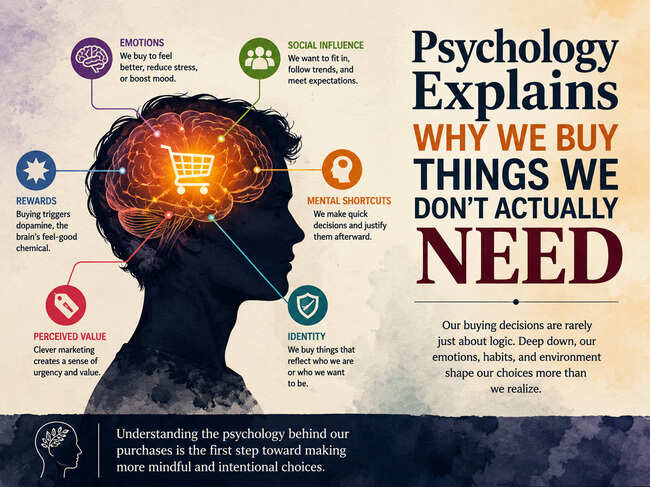
Many people walk into a store intending to buy just one item – like toothpaste – but end up leaving with candles, snacks, or a new gadget they never planned to purchase. The same thing often happens online. You might fill your shopping cart late at night with items that seemed irresistible at the time, only to wake up the next morning wondering why you bought half of them. If this sounds familiar, you’re not alone. Impulse buying is something almost everyone experiences. While it may seem like poor self-control, psychologists say our brains are wired to respond to emotional triggers, rewards, and clever marketing techniques. Retailers understand these psychological patterns and design stores and websites to encourage spontaneous purchases. Research over the past several decades has shown that emotions, stress, scarcity, and even the anticipation of owning something can influence buying decisions. Understanding these hidden mental processes can help people recognize when they’re making emotional purchases instead of practical ones.BRAIN LOVES THE REWARD OF BUYINGOne reason impulse buying feels so satisfying is that shopping activates the brain’s reward system. Neuroscientists have found that anticipating a purchase can trigger the release of dopamine, a neurotransmitter linked to motivation and pleasure. A landmark study – Neural Predictors of Shopping – by Dr. Brian Knutson and colleagues at Stanford University, published in Neuron (2007), used brain imaging to examine shopping decisions. The researchers discovered that activity increased in the nucleus accumbens – a key reward center – when participants saw products they wanted. The excitement often occurred before the purchase itself, showing that the expectation of getting something new can be just as rewarding as owning it. This explains why adding items to an online cart or spotting a ‘limited-time deal’ can create an emotional rush, even if the product isn’t necessary.EMOTIONS OFTEN DRIVE SPENDING MORE THAN LOGICMany purchases are emotional rather than rational. People frequently shop when they feel stressed, bored, lonely, or even happy. Buying something new can temporarily improve mood, which is why the behavior is sometimes called ‘retail therapy’. Research by Jennifer Lerner of Harvard University and Deborah Small (published in Psychological Science, 2004) found that emotions significantly influence financial decisions. Their work showed that feelings such as sadness can increase willingness to spend money because people unconsciously seek experiences that improve their emotional state. Psychologists say emotional spending offers only short-term relief. Once the excitement fades, buyers often experience regret, leading to a cycle of spending to chase another emotional boost.SCARCITY AND DISCOUNTS TRICK THE MINDRetailers frequently use phrases like ‘Only 2 left’, ‘Flash Sale’, or ‘Offer Ends Tonight’. These messages create a sense of urgency that makes products seem more valuable. Behavioral economist Dr. Robert Cialdini, author of ‘Influence: The Psychology of Persuasion’, identified scarcity as one of the strongest psychological principles affecting decision-making. When people believe an opportunity is limited, they become more motivated to act quickly, often without carefully considering whether they actually need the item. Other studies in consumer psychology have found that countdown timers, exclusive offers, and limited-edition products increase impulse purchases because they trigger a fear of missing out (FOMO). In these moments, the brain focuses more on avoiding loss than making a logical financial decision.SMALL HABITS CAN REDUCE IMPULSE SPENDINGThe good news is that understanding these psychological triggers makes them easier to manage. Consumer researchers recommend creating a shopping list before entering a store, waiting 24 hours before making expensive purchases, and avoiding shopping during periods of stress or emotional distress. Behavioral economist Dr. Richard Thaler, who won the 2017 Nobel Prize in Economic Sciences for his work on behavioral economics, has shown that small changes in decision-making environments can improve financial choices. Simple habits – such as removing saved payment information or setting a spending budget – can reduce impulsive purchases by giving the rational part of the brain time to catch up with emotional impulses.Impulse buying is a natural part of human psychology, but recognizing how the brain responds to rewards, emotions, and scarcity can help people make more thoughtful decisions. The next time an irresistible deal appears, taking a moment to pause may be the smartest purchase of all.Add 
as a Reliable and Trusted News Source

Add Now!
Read More News on
psychology of spendingimpulse buyingemotional triggers in shoppingretail therapyscarcity marketing strategiesconsumer psychologyneuroscience of shoppingaddiction to online shoppingdecision making in shoppingmanaging impulse purchases
Read More News on
psychology of spendingimpulse buyingemotional triggers in shoppingretail therapyscarcity marketing strategiesconsumer psychologyneuroscience of shoppingaddiction to online shoppingdecision making in shoppingmanaging impulse purchases
Stories you might be interested in
