


Download PDF
Statins reduce cardiovascular risk but modestly increase type 2 diabetes (T2D). Evidence is limited by underrepresentation of women and lack of sex-specific analyses. In an umbrella review and meta-analysis of 21 trials with sex-disaggregated data, statins increased T2D risk similarly in women (OR 1.28) and men (OR 1.24). However, absence of study-level data precluded assessment of statin-specific or absolute risks, highlighting the need for more research in this area
Introduction
Cardiovascular disease (CVD) is the leading cause of death globally, and statins are a cornerstone of guideline-directed therapy for both primary and secondary prevention. Their widespread use reflects strong evidence for reductions in low-density lipoprotein cholesterol (LDL-c) and cardiovascular events. However, statin use is also associated with a modest but statistically significant increase in incident type 2 diabetes (T2D), as demonstrated in a meta-analysis of statin trials by the Cholesterol Treatment Trialists’ Collaboration (CTTC)1.
CVD is the leading cause of death for both males and females in the United States, though age of onset differs by sex2. Despite this, the evidence base that informs statin guidelines is limited by the underrepresentation of females3. Clinically meaningful differences in cardiometabolic disease by sex, such as later CVD onset4, differing distribution of some CVD subtypes5, and greater diabetes-associated CVD risk in females6 support routine reporting of treatment effects by sex, yet treatment recommendations are frequently extrapolated from randomized controlled trials (RCT) conducted predominantly or, in a few cases, entirely in males (e.g., the West of Scotland Coronary Prevention Study7, the Multiple Risk Factor Intervention Trial [MRFIT]8, the Helsinki Heart Study9, the Lipid Research Clinics Coronary Primary Prevention Trial10, and the Veterans Affairs High-Density Lipoprootein Cholesterol Intervention Trial11, among others). Among 60 lipid-lowering RCTs conducted from 1990 to 2018, women comprised only 28.5% of participants, and common eligibility restrictions included enrollment of only postmenopausal or surgically sterile women12, gaps that are increasingly relevant as recent ACC/AHA cholesterol guidelines support earlier initiation of lipid-lowering therapy, including for some adults as young as 30 years13. Sex-stratified analyses were not routinely performed, although this has improved recently14 (e.g., NIH NOT-OD-15-10215).
One domain in which questions remain is the role of sex in statin-associated diabetes risk. A meta-regression analysis of statin RCTs suggested that diabetes risk increased with the proportion of females enrolled in the trial16. Correspondingly, in a meta-analysis of observational studies, statin use was associated with more CVD events prevented than diabetes cases in both sexes, but the net benefit was smaller in females17. However, the CTTC analysis found that the relative effect of statin therapy on incident T2D risk was similar in females and males treated with low/moderate- or high-intensity statins1. Potential biologic explanations for statin-associated diabetes risk may also point to sources of heterogeneity: evidence from genome-wide association studies suggests shared genetic pathways between LDL-c lowering response to statins and diabetes risk18, with 3-hydroxy-3-methylglutaryl-coenzyme A reductase (HMGCR)/mevalonate-related mechanisms postulated to affect insulin secretion19 and insulin sensitivity20. This is accompanied by emerging experimental evidence suggesting that X-chromosome dosage and mitochondrial dysfunction may contribute to sex-specific differences in statin-associated dysglycemia. Whether these pathways translate into clinical differences by sex (or menopausal status) remains unclear. An important next step is to extend the work by evaluating sex-specific absolute risks and whether participant-specific characteristics (such as age and menopausal status) or statin-specific characteristics (such as treatment intensity) contribute to clinically meaningful differences in risk not captured by proportional effects alone.
Methods
To begin to address these questions, we sought to estimate sex-specific risks of statin-associated diabetes using data from RCTs of statins for primary and secondary prevention of CVD. We undertook an umbrella review of systematic reviews and meta-analyses (PROSPERO registration: CRD42023465344), including articles published from database inception to 12 March 2024, focusing specifically on placebo- or usual-care–controlled designs reporting incident diabetes. Trial-level data were extracted on diabetes incidence overall and, where available, by sex along with statin type, dose, follow-up duration, and participant characteristics. Risk of bias was assessed using the Risk of Bias instrument for Use in SysTematic reviews for Randomized Controlled Trials (ROBUST-RCT)21. Pooled odds ratios for incident diabetes were estimated using random-effects meta-analysis, with subgroup analyses to examine sex-specific effect modification.
Results
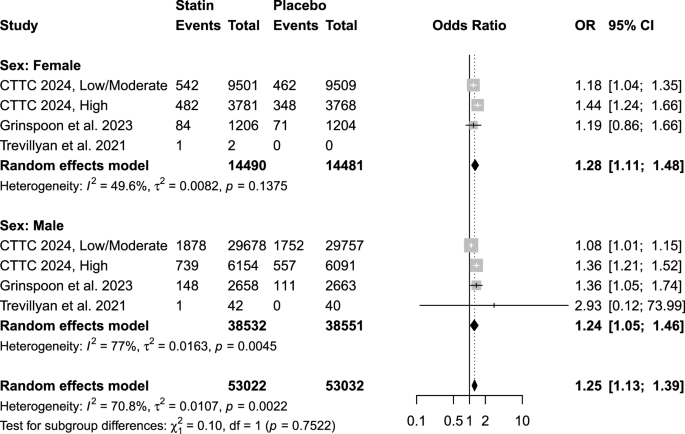
We identified 21 eligible studies (15 included in the CTTC analysis, 6 not included); however, none reported sex-stratified diabetes incidence. We contacted authors to request sex-disaggregated study-level data, and when responses were limited, engaged the CTTC. Using this approach, we were able to obtain data from all trials included in the CTTC analysis as well as study-level data for two additional trials22,23. Females comprised 27% of the analytic population (n = 28,971). Statin therapy was associated with a similar increase in type 2 diabetes risk in females (OR 1.28, 95% CI 1.11–1.48) and males (OR 1.24, 95% CI 1.05–1.46), with an overall pooled OR of 1.25 (95% CI 1.13–1.39) (Fig. 1).
The figure shows pooled odds ratios for incident diabetes associated with statin use, including sex-specific subgroup analyses. CI confidence interval, CTTC Cholesterol Treatment Trialists’ Collaboration, df degrees of freedom, OR odds ratio
Discussion
In the current analysis, we found a similar ~25% greater odds of incident T2D with statin exposure in both females and males. The number of incident T2D cases in females (n = 1834) was adequate to support robust estimates of sex-stratified risks; however, the analysis may still have been underpowered to identify modest sex-specific differences24; thus, the extent to which female underrepresentation contributed to the null interaction remains uncertain. However, the absence of study- or participant-level sex-disaggregated data precluded our ability to assess whether pharmacological characteristics or treatment intensity might produce meaningful sex-specific differences in diabetes risk. It also impeded estimation of sex-specific absolute risks, which depend on baseline diabetes incidence and differ between females and males across age, risk strata, and menopausal status. Given the major benefits of statins for CVD risk reduction, it is unlikely that such findings would argue against statin use in patients with clear indications; rather, a more nuanced understanding of sex-specific and statin-specific risk profiles may inform the timing, choice, and intensity of therapy to support thoughtful shared decision-making in primary CVD prevention. In cardiometabolic health, next steps toward precision medicine may take the form of care tailored to characteristics that might meaningfully modify risk and treatment response. Based on what we know about the role of sex in life course risk of conditions such as CVD and T2D, additional work is needed to understand sex-specific risks and benefits, including sex-disaggregated estimates by statin and treatment intensity, and absolute risk estimates across relevant age and risk strata. Such reconsideration of the evidence is required to fully characterize the balance of risks and benefits of statin therapy for females and males across the life course, so that prescription and use of statins are based on sex-specific evidence.
Data availability
The datasets generated and/or analyzed during the current study are not publicly available because they consist of extracted data from published studies included in this systematic review, but are available from the corresponding author on reasonable request
References
Cholesterol Treatment Trialists’ CollaborationEffects of statin therapy on diagnoses of new-onset diabetes and worsening glycaemia in large-scale randomised blinded statin trials: an individual participant data meta-analysis. Lancet Diabetes Endocrinol.12, 306–319 (2024)
Freedman, A. A. et al. Sex differences in age of onset of premature cardiovascular disease and subtypes: the Coronary Artery Risk Development in Young Adults Study. J. Am. Heart Assoc.15, e044922 (2026)
Regensteiner, J. G. & Reusch, J. E. B. Sex differences in cardiovascular consequences of hypertension, obesity, and diabetes: JACC Focus Seminar 4/7. J. Am. Coll. Cardiol.79, 1492–1505 (2022)
El Khoudary, S. R. et al. Menopause transition and cardiovascular disease risk: implications for timing of early prevention: a scientific statement from the American Heart Association. Circulation142, e506–e532 (2020)
Bairey Merz, C. N., Pepine, C. J., Walsh, M. N. & Fleg, J. L. Ischemia and no obstructive coronary artery disease (INOCA): developing evidence-based therapies and research agenda for the next decade. Circulation135, 1075–1092 (2017)
Regensteiner, J. G. et al. Sex differences in the cardiovascular consequences of diabetes mellitus: a scientific statement from the American Heart Association. Circulation132, 2424–2447 (2015)
Shepherd, J. et al. Prevention of coronary heart disease with pravastatin in men with hypercholesterolemia. N. Engl. J. Med.333, 1301–1307 (1995)
Multiple Risk Factor Intervention Trial Research Group. Multiple Risk Factor Intervention Trial: risk factor changes and mortality results. JAMA248, 1465–1477 (1982)
Frick, M. H. et al. Helsinki Heart Study: primary-prevention trial with gemfibrozil in middle-aged men with dyslipidemia. N. Engl. J. Med.317, 1237–1245 (1987)
Lipid Research Clinics Program. The Lipid Research Clinics Coronary Primary Prevention Trial results. I. Reduction in incidence of coronary heart disease. JAMA251, 351–364 (1984)
Rubins, H. B. et al. Gemfibrozil for the secondary prevention of coronary heart disease in men with low levels of high-density lipoprotein cholesterol. N. Engl. J. Med.341, 410–418 (1999)
Khan, S. U. et al. Participation of women and older participants in randomized clinical trials of lipid-lowering therapies: a systematic review. JAMA Netw. Open3, e205202 (2020)
Blumenthal, R. S. et al. 2026 ACC/AHA/AACVPR/ABC/ACPM/ADA/AGS/APhA/ASPC/NLA/PCNA guideline on the management of dyslipidemia: a report of the American College of Cardiology/American Heart Association Joint Committee on Clinical Practice Guidelines. Circulation153, e1154–e1276 (2026)
Kim, H., Park, J., Ahn, S. & Lee, H. The impact of sex/gender-specific funding and editorial policies on biomedical research outcomes: a cross-national analysis (2000–2021). Sci. Rep.14, 26599 (2024)
NIH Office of Extramural Research. Consideration of Sex as a Biological Variable in NIH-funded Research (NOT-OD-15-102). National Institutes of Health https://grants.nih.gov/grants/guide/notice-files/not-od-15-102.html (2015)
Goodarzi, M. O., Li, X., Krauss, R. M., Rotter, J. I. & Chen, Y. D. Relationship of sex to diabetes risk in statin trials. Diabetes Care36, e100–e101 (2013)
Engeda, J. C. et al. Projections of incident atherosclerotic cardiovascular disease and incident type 2 diabetes across evolving statin treatment guidelines and recommendations: a modelling study. PLoS Med.17, e1003280 (2020)
Smit, R. A. J. et al. Statin-induced LDL cholesterol response and type 2 diabetes: a bidirectional two-sample Mendelian randomization study. Pharmacogenomics J20, 462–470 (2020)
Barrow, B. M., Wander, P. L. & Zraika, S. From cholesterol to glucose: uncovering how statins induce β-cell dysfunction to promote type 2 diabetes. J. Endocrinol.266, e250048 (2025)
She, J. et al. Statins aggravate insulin resistance through reduced blood glucagon-like peptide-1 levels in a microbiota-dependent manner. Cell Metab36, 408–421.e5 (2024)
Wang, Y. et al. Development of ROBUST-RCT: Risk Of Bias instrument for Use in SysTematic reviews-for Randomised Controlled Trials. BMJ388, e081199 (2025)
Fitch, K. V. et al. Diabetes risk factors in people with HIV receiving pitavastatin versus placebo for cardiovascular disease prevention: a randomized trial. Ann. Intern. Med.177, 1449–1461 (2024)
Trevillyan, J. M. et al. Impact of rosuvastatin on atherosclerosis in people with HIV at moderate cardiovascular risk: a randomised, controlled trial. AIDS35, 619–624 (2021)
Peters, S. A. E. et al. Sample size considerations to assess sex-related treatment effects. Eur. Heart J.47, 1790–1798 (2026)
Acknowledgements
We acknowledge the contributions of Teresa Jewell, who designed and conducted the literature searches for this systematic review, as well as Josephine Chou, MD, Samantha Thielen, MD, and Jenny Tong, MD, who helped with the systematic reviews. AI-assisted editing for readability was performed using ChatGPT (GPT-5.5, OpenAI). No funding was received for this work. The views expressed in this manuscript are those of the authors and do not reflect the position or policy of the Department of Veterans Affairs or the United States government.
Author information
Author notes
These authors contributed equally: Pandora L. Wander, Ana J. Pinto
Authors and Affiliations
Veterans Affairs (VA) Puget Sound Health Care System, Seattle, WA, USA
Pandora L. Wander
Department of Medicine, University of Washington, Seattle, WA, USA
Pandora L. Wander
Division of Endocrinology, Metabolism and Diabetes, Department of Medicine, School of Medicine, University of Colorado Anschutz Medical Campus, Aurora, CO, USA
Ana J. Pinto, Audrey Bergouignan & Jane E. B. Reusch
Anschutz Health and Wellness Center, University of Colorado Anschutz Medical Campus, Aurora, CO, USA
Ana J. Pinto & Audrey Bergouignan
Ludeman Family Center for Women’s Health Research, University of Colorado Anschutz Medical Campus, Aurora, CO, USA
Ana J. Pinto, Mary O. Whipple, Jane E. B. Reusch & Judith G. Regensteiner
School of Nursing, University of Minnesota, Minneapolis, MN, USA
Mary O. Whipple
Department of Psychological and Brain Sciences, University of Iowa, Iowa City, IA, USA
Alyssa S. Carlson
Institut Pluridisciplinaire Hubert Curien, Centre National de la Recherche Scientifique, Université de Strasbourg UMR7178, Strasbourg, France
Audrey Bergouignan
Rocky Mountain Regional VA Medical Center, Denver, CO, USA
Jane E. B. Reusch
Divisions of General Internal Medicine and Cardiology, Department of Medicine, University of Colorado Anschutz Medical Campus, Aurora, CO, USA
Judith G. Regensteiner
Authors
- Pandora L. WanderView author publications
Search author on:PubMed Google Scholar
- Ana J. PintoView author publications
Search author on:PubMed Google Scholar
- Mary O. WhippleView author publications
Search author on:PubMed Google Scholar
- Alyssa S. CarlsonView author publications
Search author on:PubMed Google Scholar
- Audrey BergouignanView author publications
Search author on:PubMed Google Scholar
- Jane E. B. ReuschView author publications
Search author on:PubMed Google Scholar
- Judith G. RegensteinerView author publications
Search author on:PubMed Google Scholar
Contributions
P.L.W. and A.J.P. contributed equally to this work; P.L.W. wrote the first draft of the manuscript, and A.J.P. performed the analyses. P.L.W., A.J.P., A.S.C., A.B., J.E.B.R., and J.G.R. designed the study. P.L.W., A.J.P., A.S.C., A.B., and M.O.W. conducted the systematic reviews. All authors contributed to manuscript revision and approved the final version
Ethics declarations
Competing interests
J.G.R. is an Editorial Board Member of npj Women’s Health. J.G.R. was not involved in the journal’s review of, or decisions related to, this manuscript. The authors declare no other competing interests
Additional information
Publisher’s note Springer Nature remains neutral with regard to jurisdictional claims in published maps and institutional affiliations
Rights and permissions
Open Access This article is licensed under a Creative Commons Attribution 4.0 International License, which permits use, sharing, adaptation, distribution and reproduction in any medium or format, as long as you give appropriate credit to the original author(s) and the source, provide a link to the Creative Commons licence, and indicate if changes were made. The images or other third party material in this article are included in the article’s Creative Commons licence, unless indicated otherwise in a credit line to the material. If material is not included in the article’s Creative Commons licence and your intended use is not permitted by statutory regulation or exceeds the permitted use, you will need to obtain permission directly from the copyright holder. To view a copy of this licence, visit http://creativecommons.org/licenses/by/4.0/.
About this article
Cite this article
Wander, P.L., Pinto, A.J., Whipple, M.O. et al. Still in the dark: effects of sex differences on statin-associated diabetes risk.
npj Womens Health4, 23 (2026). https://doi.org/10.1038/s44294-026-00160-9
Received:01 May 2026
Accepted:13 July 2026
Published:17 July 2026
Version of record:17 July 2026
DOI
:https://doi.org/10.1038/s44294-026-00160-9
