


<img src="https://healthylife7.com/wp-content/uploads/2026/09/0_0nl22ipr.jpg” alt=”A human figure silhouette with highlighted liver and intestines, shown in a blue glow against a dark background.”>
Study Identifies Potential Therapeutic Target Protein that Drives Metabolic Liver Disease Independent of Diet
Study Identifies Potential Therapeutic Target Protein that Drives Metabolic Liver Disease Independent of Diet
Sep 01, 2026
Media Contact:
Sophia FriesenManager, Research Communications, University of Utah HealthEmail: sophia.friesen@hsc.utah.edu
Obesity-related metabolic liver disease affects hundreds of millions of people worldwide, but only some fraction of those livers develop scarring, become inflamed, and eventually fail. University of Utah researchers have identified a protein, EFHD1, that appears to drive that transition by triggering an out-of-place antiviral immune response.
Key points:
- New research has identified a protein, EFHD1, that drives metabolic liver disease.
- EFHD1 triggers an out-of-place antiviral immune response, making liver injury worse.
- Blocking EFHD1 protected against liver injury in human cells and mouse models.
IMPACT:Future therapies that decrease EFHD1 could help prevent liver damage, even on a high-fat diet
Distinguishing liver injury from liver fat

Chaudhuri’s lab had previously linked EFHD1 to heart attack-like injury in mice, and other groups had found that, in people, genetic variants that increase EFHD1 were consistently linked to liver injury—but not to the accumulation of excess liver fat itself. Most genes linked to obesity-related metabolic liver disease affect lipid metabolism.
EFHD1 was different, suggesting a separate pathway that determines whether a fatty liver actually becomes damaged
“The amount of lipid itself is not the only factor causing injury—that threshold varies a lot,” Chaudhuri says.
“Focusing on fat metabolism has led to many clinical breakthroughs, and we think that looking at what’s actually happening that causes the injury will yield just as much benefit.”
“The liver thinks it’s under viral attack”
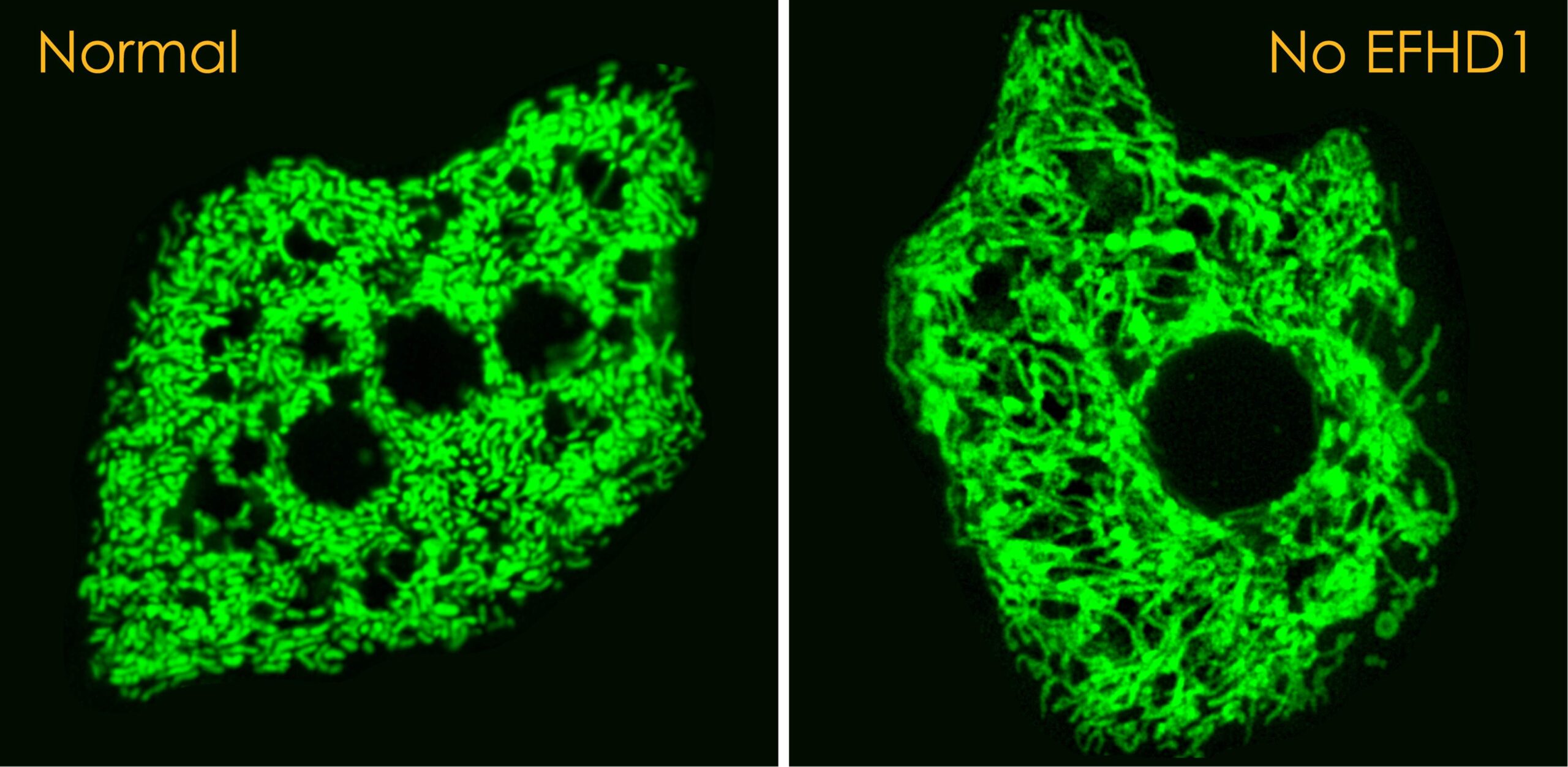
To find out what EFHD1 does, the researchers examined mice genetically engineered to lack the protein. In mice without EFHD1, liver mitochondria appeared stretched into long, spaghetti-like strands rather than their normal compact bean shape
Using biochemical and imaging tests, the team found that EFHD1 tethers mitochondria to a nearby organelle called the endoplasmic reticulum and helps trigger mitochondrial division. Mitochondria lacking EFHD1 are so long and skinny because they don’t divide as often.
On the other hand, when mice are fed a fatty, sugary diet that induces liver injury, excess lipids drive up EFHD1 levels, which makes mitochondria divide so much that they start leaking their contents into the rest of the cell. Those contents include double-stranded RNA, which can also appear in the main body of the cell if it’s been infected by certain viruses, like hepatitis C. Upon detecting the mitochondrial double-stranded RNA in the cytoplasm, the cell activates an antiviral defense pathway.
“It’s almost like obesity is making the liver think it’s under viral attack,” Chaudhuri said
Blocking EFHD1 reduces liver injury
That antiviral stress response, meant to prevent viral replication in infected cells, instead shuts down healthy but strained liver cells, worsening injury. When the researchers blocked or reduced the levels of EFHD1, measures of inflammation and liver scarring dropped by roughly 30 to 60%, in both diet-induced and drug-induced mouse liver injury models, as well as in human liver organoids
Current drugs for obesity-related metabolic liver disease primarily target lipid metabolism and frequently only partially resolve liver injury. The researchers view EFHD1 as a complementary target for new therapies. “We think this is a unique opportunity because even if these other drugs work, the effects are often partial,” Chaudhuri said.
The research team is currently working to develop therapies to decrease EFHD1 levels, building on work covered by a patent filed by the university
Reassuringly, mice engineered to lack EFHD1 have normal activity levels, weight gain, and other measures of metabolism, which suggests that treatments that block EFHD1 would have few side effects
Future studies will explore whether the same pathway drives injury in metabolic diseases of the heart and other organs, and whether it also contributes to alcohol-related liver damage
###
The results are published in the Journal of Clinical Investigation as “Excessive EFHD1-dependent ER-mitochondrial contacts drive a maladaptive antiviral response in metabolic liver disease.”
The research was supported by the Nora Eccles Treadwell Foundation, the Larry H. Miller Driving Out Diabetes initiative, the American Heart Association, and the National Institutes of Health. Co-authors include researchers across several departments at the University of Utah, as well as those from the University of Maryland, InSphero AG, Thermo Fisher Scientific, and the Indiana University School of Medicine. Content is solely the responsibility of the authors and does not necessarily represent the official views of the National Institutes of Health.
David Eberhardt and Dipayan Chaudhuri are inventors on a provisional patent filed by the University of Utah that covers the pathways discussed here. Coauthor Scott Summers is cofounder and shareholder of Centaurus Therapeutics. Coauthor Jared Rutter is a founder of Vettore Biosciences and a member of its scientific advisory board. The other authors declare no competing financial interests
