


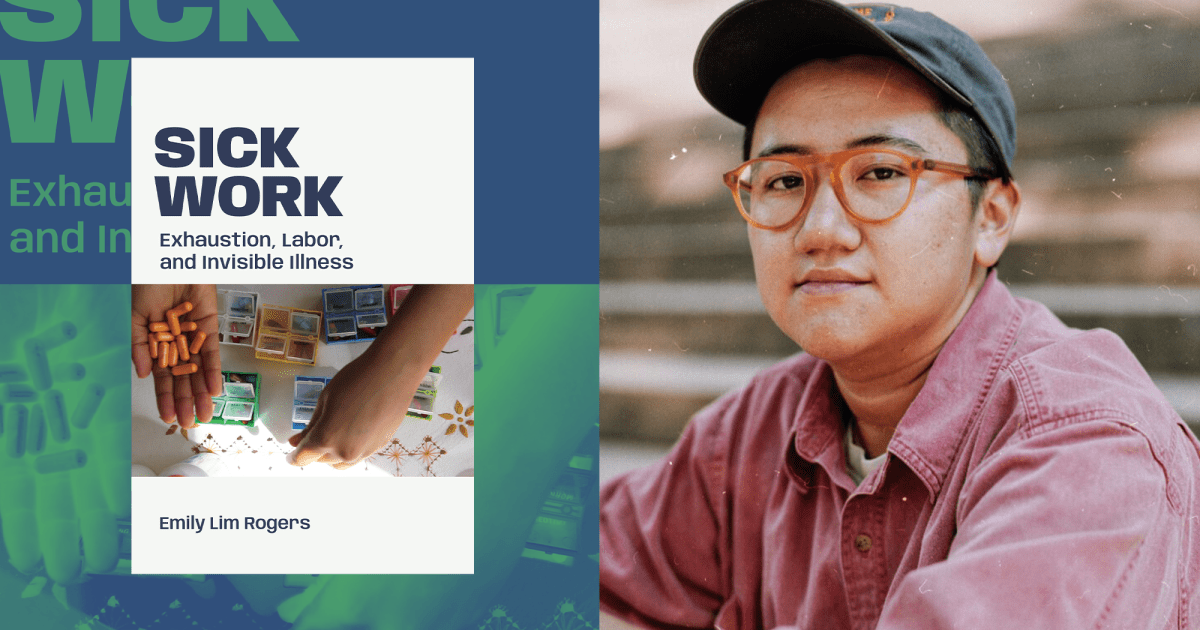
“The work and everyday labor of living with ME/CFS contains this recursive loop of everyday labor of being ill, where you can’t work, but you need to work,” said Emily Lim Rogers.Mother Jones; courtesy Emily Lim Rogers; Duke University Press
Get your news from a source that’s not owned and controlled by oligarchs. Sign up for the free Mother Jones Daily.
Inlate 1984,dozens of people in the region of Lake Tahoe, California, would go to the doctor with a variety of symptoms, including debilitating fatigue—the first clearly documented cluster of what the Centers for Disease Control and Prevention would label “chronic fatigue syndrome” towards the end of the ’80s
Today, that complex condition is known as ME/CFS, or myalgic encephalomyelitis/chronic fatigue syndrome. In its more severe manifestations, it can leave people unable to get out of bed independently, needing to be tube-fed. Even in its minor forms, it can be life-altering
I would know: I received an ME/CFS diagnosis in 2023. It’s not a rare condition—it’s estimated that around half of the millions of people with long Covid may have ME/CFS— but it is still widely misunderstood. Pushing oneself too hard to get “through” it, for one thing, doesn’t help build tolerance, and can instead lead to crashes known as post-exertional malaise
Duke University cultural anthropologist Emily Lim Rogers looks at the labor it takes simply to exist while sick in her new book Sick Work: Exhaustion, Labor, and Invisible Illness, through the lens of ME/CFS. We spoke about the history of the condition, the importance of acknowledging differently racialized experiences of chronic illness, and the compounding exhaustion of being ill
This interview has been edited for length and clarity
How has debilitating fatigue beendownplayed since the Industrial Revolution, and how does that connect to work?
In the US, we have an idea that it’s normal to be burnt out. Fatigue and burnout are systemically denied from workers’ compensation claims; this is actually not the case in all countries
“Fatigue is this term that’s so banal and non-exceptional. We accept it as completely mundane and something that everyone should be: fatigued.”
The concept of fatigue was initially conceived of as something that could be solved, particularly in the context of an understanding of the body as a machine, in the late 19th century. Fatigue did not enter English-language medical journals until the last decade of the 19th century. The first chapter of the book looks at how fatigue went from a problem that could be solved, and should be worked on—granted, for maximum productivity—to something that just became accepted as part of everyday life.
Stress was a concept that only gained widespread acceptance as a legitimate scientific phenomenon in the 1970s
When I was looking at people with ME/CFS contemporarily, one might expect to find sort of a paradigm of hysteria [and dismissal on that basis], like women’s chronic illnessesare obviously disproportionately affected by chronic fatigue syndrome. But what I found was that most people were not dismissed as kind of crazy hysterics—though that certainly echoes as well—but from an idea that they were just working too hard
But then, that’s interesting, because our solution is not, “Maybe we should give these people disability insurance, maybe we should give these people time off work.” Instead, it’s, “You cannot handle the conditions of everyday life under capitalism. You’re just fatigued. You’re just burnt out.”
Now, people with ME/CFS have a qualitatively different type of fatigue than fatigue from work. [But] I think if we were to challenge the idea that some people have debilitating fatigue in addition to other non-specific symptoms, it would fundamentally raise the question of: Should we all be tired all the time in the first place?
You writethat “Sick work is not about rehabilitation into the workforce or the reproduction of labor power: It is treading water with a body that has already been rendered unproductive.”That really hit me hard. In what ways do you think the capitalist society we live in degrades the amount of work it takes for chronically ill people, whether they have ME/CFS or another condition, to survive?
Part of my argument is that we call these illnesses “invisible illnesses,” because you can’t necessarily tell that someone’s sick. That’s true, but, for some people, it’s very much not invisible. I would describe these illnesses as invisibleized, more accurately. And part of my argument is that the invisible labor, and the invisibilization of the labor, that it takes to be sick leads to the invisibilization, and minimization politically, of many diseases like ME/CFS
“In US culture, we have a huge kind of panic over the idea that someone is faking it.”
The work and everyday labor of living with ME/CFS contains this recursive loop of everyday labor of being ill, where you can’t work, but you need to work
The engine of capitalism, as I describe in the [book], is fatigue: the depletion of bodily capacity to its absolute limit. If all of that is depleted in simply trying to be okay, then you’re already rendered outside the fold of who we think of as a productive worker. Many people, as I show in the book, do have ME/CFS and have to work paid jobs because they have to get health insurance, but they’re barely treading water. And the only reason, for many people, is because work is their only tie to health insurance, which is the cruel irony of this whole system.
You note that some ME/CFS patient activists believe the CDC used the name “chronic fatigue” to downplay its severity
I read about it in some early reporting on ME/CFS in the ’90s. I think the question of intentionality is maybe less salient than the question of its effect. Fatigue is this term that’s so banal and non-exceptional. We accept it as completely mundane and something that everyone should be: fatigued
For people with ME/CFS, a very different type, a very, very debilitating type of fatigue that does not come proportionate to any exertion, kind of gets buried in that. It’s important to look at the nitty-gritty of the science, why something’s researched or not researched. But zooming out, I try to understand this as very deeply embedded into how capitalism operates for chronically ill people at large
How have ME/CFS patients beendismissed owing to thelack of clear, consistent biomarkersfor the condition?
Many people would look at people with ME/CFS, especially those very active in the patient activist movement, and say, “Oh, these are a bunch of bougie white women”—and that’s true in terms of who can get a diagnosis. We would say that the bourgeois white woman is so opposite of the figure of the welfare queen, the person who wants a cop-out from work, right?
I actually think these figures are not completely distinct, because in US culture, we have a huge kind of panic over the idea that someone is faking it, and thus taking taxpayer dollars, and just lazy
“Many people of color that I talk to didn’t even consider that they might have ME/CFS…People can really internalize: Am I worthy to be ill, or am I not?”
I think that the lack of biomarkers creates that panic, and biomarkers became the idea of objective proof of illness and became more important in disability determinations in the neoliberal era
We saw it in the gutting of the social safety netunder Reagan, continuing obviously under Clinton, and this is obviously very relevant to what we’re seeing now with all of the cuts in Medicaid. What we have or don’t have [reduced to] biomarkers is political, and how that meets and meshes with actual everyday interactions in the disability determinations office, with health insurance companies, is sort of a distillation of all that. All those sources come crashing in [together] to shape the dismissal of ME/CFS.
As you mentioned,ME/CFS has often been portrayed as a rich white women’s disease, which is just not accurate. Could you tell me about your takeaways from your conversation with Robin, a Black woman with ME/CFS?
Not only was there the shocking anecdote that even a Black doctor would tell her, “No, just keep pushing on,” it raised a larger point. It is always about who has the money, reso something where it cuts deeper, to who sees themselves as someone who can be legitimately ill
The portrayal of ME/CFS as a bourgeois white woman’s disease does not help. Many people of color that I talk to didn’t even consider that they might have ME/CFS, so I think people can really internalize: Am I worthy to be ill, or am I not? And should I just push on, or should I not?
