


By MATTHEW M. BURKE STARS AND STRIPES
HOHENFELS, Germany — The ongoing warfare evolution in the two years since the Italy-based 173rd Mobile Brigade (Airborne) last participated in the annual exercise Saber Junction was never more evident than it was this week, just ahead of their arrival
The resident opposition force at the Joint Multinational Readiness Center in Bavaria — the 1st Battalion, 4th Infantry Regiment — laid out what it had in store for the incoming Sky Soldiers, from new reconnaissance and attack drones to the latest in electronic jamming equipment
“It’s not going to be the same fight they saw two years ago, but they’ve been changing too,” battalion commander Lt. Col. Michael Cryer said. “Everybody’s adapting right now. This will be a good test.”
The leader of 7th Army Training Command, Brig. Gen. Terry Tillis, said things might not go well for the 173rd, at least initially
“We have 1,900 autonomous systems in this rotation,” Tillis said Wednesday as he surveyed the equipment on the eve of the exercise. “That’s a lot.”
A reconnaissance drone sits next to a mock enemy vehicle used by the opposition force ahead of exercise Saber Junction in the Hohenfels Training Area, Germany, Aug. 26, 2026. The exercise is designed to replicate a peer adversary modeled on Russia as part of NATO’s Eastern Flank Deterrence Initiative. (Matthew M. Burke/Stars and Stripes)
The domains covered include space, the cyber arena and electronic warfare, while the arsenal in the field ran the gamut from autonomous systems to weapons of both the direct- and indirect-fire variety as well as a
Another feature is replication of long-range artillery strikes, he added
Saber Junction tests regional plans in support of NATO’s Eastern Flank Deterrence Initiative against a peer threat designed to mimic the Russian military
A soldier with 1st Battalion, 4th Infantry Regiment prepares for the arrival of the 173rd Airborne Brigade Combat Team as inflatable decoy vehicles, meant to confuse aerial drones, sit in the background in the Hohenfels Training Area, Germany, Aug. 26, 2026. The decoys reflect how heavily both sides are leaning on drones and counter-drone tactics throughout this year’s exercise. (Matthew M. Burke/Stars and Stripes)
Other participants this year include Germany, Italy, Poland and Ukraine. This year’s exercise, which ends Sept. 13, is shaping up to be the most tech-focused version of Saber Junction to date
It features over 5,000 U.S. and European troops, including 3,300 soldiers from the 173rd, which is divided between nearby Grafenwoehr and the Italian city of Vicenza
During this year’s exercise, a battalion from the 173rd that was tasked with absorbing lessons about drone tactics from the Ukrainian military will present what it’s learned, an Army official said last week, amid headlines about the service ordering the battalion to phase out its focus on drone tactics and return to “core warfighting tasks” as an infantry unit
This iteration is also the first for a new company of the 1st battalion that was fielded in January and specializes in reconnaissance at all ranges
Led by Capt. Luther Salmon, it deploys the latest drone and electronic warfare technology to provide timely and accurate battlefield intelligence to planners trying to provide the most realistic test
A soldier with 1st Battalion, 4th Infantry Regiment recovers a drone after a test flight in the Hohenfels Training Area, Germany, Aug. 26, 2026. Saber Junction, which runs through Sept. 13, is testing how U.S. and allied forces adapt to an increasingly drone-saturated battlefield modeled on Russian tactics. (Matthew M. Burke/Stars and Stripes)
The collection of drones and detection equipment laid out by company soldiers Wednesday on the eve of Saber Junction wouldn’t have been out of place at the largest of tech conferences
There were surveillance drones like the Skydio X10, Vesper, eBee Vision, Vector AI, Stork, Neros Archer first-person-view attack drones and the multi-purpose C100, which can observe and drop munitions
“This is the future right now,” said drone expert Sgt. 1st Class Eric Navarro. “If you can’t hide from these things, it’s not going to be a good day for you.”
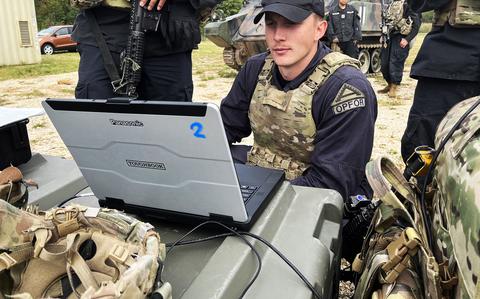
Across the road, Sgt. Robert Nemec and his team were readying a host of electronic warfare devices that can be carried by soldiers to detect and disrupt enemy communications
Their toolkit included the TLS Manpack system and Beast+, as well as the drone-detecting EchoShield high-fidelity radar. They were also outfitted with the vehicle-mounted Titan detector and jammer and the Mk4 drone-disabling gun
Soldiers with 1st Battalion, 4th Infantry Regiment set up an EchoShield radar system used to detect and track drones at the Joint Multinational Readiness Center in Hohenfels, Germany, Aug. 26, 2026. The radar is one of several new electronic warfare tools the opposition force is fielding this year, along with jamming systems designed to disrupt enemy communications and disable drones. (Matthew M. Burke/Stars and Stripes)
The plan was to have the Sky Soldiers parachute in Wednesday night. They would set up a defense that would immediately be attacked by the opposition force in their black and tiger-striped uniforms
Then, in the coming days, they would go on the offensive. Both sides plan to employ drones and counter-drone technology
Army
Europe
