


Abstract
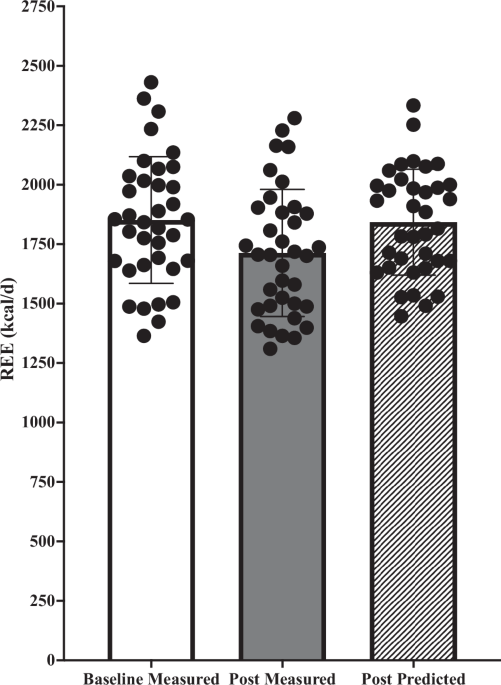
Energy restriction and resistance training (RT) are commonly used by athletes to induce body weight and fat losses and improve power to mass ratio. Weight loss-induced greater than predicted decrease in resting energy expenditure (GPDR) has repeatedly been reported in individuals with obesity. However, less is known about GPDR in trained athletes who consume adequate protein and who perform RT to maintain fat-free mass (FFM) during weight loss. Thirty-six recreational athletes (14 F; 22 M) from two separate weight loss studies were included for secondary analysis. We examined the effects of short-term weight loss with RT and adequate protein intakes on GPDR in recreational athletes. We found significant reductions in resting energy expenditure (REE) (~ -140 kcal/d; p < 0.001) and GPDR based on our prediction equation (p < 0.001). What is more, we report that the decrease in REE and the presence of GPDR were observed even in individuals who had gained FFM by the end of the interventions. Our findings suggest that even increases in FFM, by means of RT and adequate protein intake does not prevent the decline in REE, nor the onset of GPDR in recreational athletes subjected to caloric deficits and fat loss.
This is a preview of subscription content, access
Access options
Access through your institution
- Purchase on SpringerLink
- Instant access to the full article PDF.
39,95 €
Prices may be subject to local taxes which are calculated during checkout
Subjects
- Medical research
- Physiology
Data availability
The analysed data sets of the current study are not publicly available. De-identified and processed data can be requested from the corresponding author for academic purposes after completing a signed data access form. Only de-identified data can be provided to protect participant privacy
References
Helms ER, Fitschen PJ, Aragon AA, Cronin J, Schoenfeld BJ. Recommendations for natural bodybuilding contest preparation: resistance and cardiovascular training. J Sports Med Phys Fit. 2015;55:164–78
Roberts BM, Helms ER, Trexler ET, Fitschen PJ. Nutritional recommendations for physique athletes. J Hum Kinet. 2020;71:79–108
Rankin JW. Weight loss and gain in athletes. Curr Sports Med Rep. 2002;1:208–13
Miller DS, Parsonage S. Resistance to slimming: adaptation or illusion? Lancet. 1975;1:773–5
Muller MJ, Bosy-Westphal A. Adaptive thermogenesis with weight loss in humans. Obesity. 2013;21:218–28
Dulloo AG. Adaptive thermogenesis driving catch-up fat during weight regain: a role for skeletal muscle hypothyroidism and a risk for sarcopenic obesity. Rev Endocr Metab Disord. 2025;26:871–88
Doucet E, St-Pierre S, Alméras N, Després J-P, Bouchard C, Tremblay A. Evidence for the existence of adaptive thermogenesis during weight loss. Br J Nutr. 2001;85:715–23
Goele K, Bosy-Westphal A, Rumcker B, Lagerpusch M, Muller MJ. Influence of changes in body composition and adaptive thermogenesis on the difference between measured and predicted weight loss in obese women. Obes Facts. 2009;2:105–9
Knuth ND, Johannsen DL, Tamboli RA, Marks-Shulman PA, Huizenga R, Chen KY, et al. Metabolic adaptation following massive weight loss is related to the degree of energy imbalance and changes in circulating leptin. Obes (Silver Spring). 2014;22:2563–9
Dulloo AG, Jacquet J. Adaptive reduction in basal metabolic rate in response to food deprivation in humans: a role for feedback signals from fat stores. Am J Clin Nutr. 1998;68:599–606
Muller MJ, Enderle J, Pourhassan M, Braun W, Eggeling B, Lagerpusch M, et al. Metabolic adaptation to caloric restriction and subsequent refeeding: the Minnesota Starvation Experiment revisited. Am J Clin Nutr. 2015;102:807–19
Isola V, Hulmi JJ, Petaja P, Helms ER, Karppinen JE, Ahtiainen JP. Weight loss induces changes in adaptive thermogenesis in female and male physique athletes. Appl Physiol Nutr Metab. 2023;48:307–20
Kanaan MF, Nait-Yahia S, Doucet E. The effects of high protein intakes during energy restriction on body composition, energy metabolism and physical performance in recreational athletes. Eur J Clin Nutr. 2025;79:544–52
Nait-Yahia S, Kanaan MF, Beauregard N, Anderton MJ, Duval A, Doucet É. A 4-week caloric restriction with high volume resistance-training and high-protein diet does not increase fat-free mass sparing but increases strength. Eur J Clin Nutr. 2026;8:1–10
Abdulnour J, Doucet E, Brochu M, Lavoie JM, Strychar I, Rabasa-Lhoret R, et al. The effect of the menopausal transition on body composition and cardiometabolic risk factors: a Montreal-Ottawa New Emerging Team group study. Menopause. 2012;19:760–7
Cadieux S, McNeil J, Lapierre MP, Riou ME, Doucet E. Resistance and aerobic exercises do not affect post-exercise energy compensation in normal weight men and women. Physiol Behav. 2014;130:113–9
Elia M. Organ and tissue contribution to metabolic rate. In: Kinney JM, Tucker HN (eds). Energy metabolism: tissue determinants and cellular corollaries. Raven Press, New York; 1992, pp. 61–80
Muller MJ, Bosy-Westphal A, Kutzner D, Heller M. Metabolically active components of fat-free mass and resting energy expenditure in humans: recent lessons from imaging technologies. Obes Rev. 2002;3:113–22
Nunes CL, Casanova N, Francisco R, Bosy-Westphal A, Hopkins M, Sardinha LB, et al. Does adaptive thermogenesis occur after weight loss in adults? A systematic review. Br J Nutr. 2022;127:451–69
Leibel RL, Rosenbaum M, Hirsch J. Changes in energy expenditure resulting from altered body weight. N Engl J Med. 1995;332:621–8
Nunes CL, Rosa GB, Jesus F, Heymsfield SB, Minderico CS, Martins P, et al. Interindividual variability in metabolic adaptation of non-exercise activity thermogenesis after a 1-year weight loss intervention in former elite athletes. Eur J Sport Sci. 2023;23:1761–70
Acknowledgements
We thank all participants for taking part in our research
Author information
Authors and Affiliations
Faculty of Health Sciences, School of Human Kinetics, University of Ottawa, Ottawa, ON, Canada
Mikael F. Kanaan, Samir Nait-Yahia & Éric Doucet
Authors
- Mikael F. KanaanView author publications
Search author on:PubMed Google Scholar
- Samir Nait-YahiaView author publications
Search author on:PubMed Google Scholar
- Éric DoucetView author publications
Search author on:PubMed Google Scholar
Contributions
MFK and ÉD: Conceptualisation, data analysis, writing and editing; SNY and MFK: Data collection, writing and editing. All authors approved the final version
Ethics declarations
Competing interests
The authors declare no competing interests
Additional information
Publisher’s note Springer Nature remains neutral with regard to jurisdictional claims in published maps and institutional affiliations
Supplementary information
Prescribed and reported energy and macronutrient intakes. (download DOCX )
Participants’ baseline characteristics. (download DOCX )
Model-building table for covariates related to measured REE before the intervention. (download DOCX )
Model-building table for covariates related to measured REE after the intervention. (download DOCX )
Rights and permissions
Springer Nature or its licensor (e.g. a society or other partner) holds exclusive rights to this article under a publishing agreement with the author(s) or other rightsholder(s); author self-archiving of the accepted manuscript version of this article is solely governed by the terms of such publishing agreement and applicable law
About this article
Cite this article
Kanaan, M.F., Nait-Yahia, S. & Doucet, É. The increase in fat-free mass during weight loss does not prevent greater than predicted reductions in resting energy expenditure in recreational athletes.
Int J Obes (2026). https://doi.org/10.1038/s41366-026-02179-z
Received:09 January 2026
Accepted:20 July 2026
Published:30 July 2026
Version of record:30 July 2026
DOI
:https://doi.org/10.1038/s41366-026-02179-z
