


To reach a goal in life, a person sometimes needs to walk down the right corridor
and open a door at the end
That’s what a group of University of South Florida students are doingtive. The program provides up to $10,000 to each of USF’s
nine participating colleges. The funds help students with financial obligations and
frees up time to work with faculty
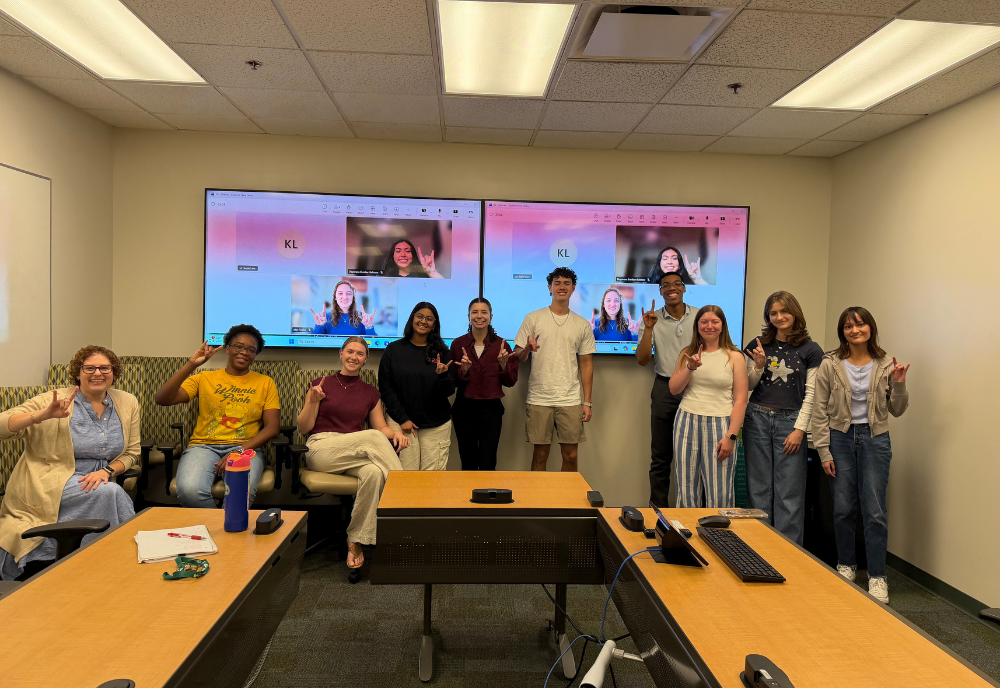
In the College of Public Health (COPH), the program supports research experiences for seven undergraduate students,
who work 10 hours a week for 10 weeks on faculty mentor-guided projects
This year, the annual COPH initiative received 160 applications for 15 student positions,
making the slots highly competitive. The students see their involvement as a springboard
to advancing their careers through invaluable boots-on-the-ground training, said Dr. Alison Oberne, associate dean, undergraduate studies and assistant professor in the Department of Community Health Sciences
“The students gain new skills and mentorship that support their professional growth
and development,’’ she said. “Students often join research labs in various stages
of a project so they learn about the lifecycle of research. They have an opportunity
to learn about different types of research, contribute to research initiatives and
receive mentorship.’’
“Some students are interested in research but either lack a mentor or the time to
volunteer in a lab,’’ Oberne added. “Many students take classes full time and work
part-time jobs, so this funding supports their professional and academic goals and
allows them to better manage their day-to-day expenses.’’
Julissa Velazquez, an undergraduate student majoring in public health who hopes to join the Peace Corps, was thrilled to be awarded a position for further
study. Her project focused on a joint COPH-Florida Department of Health program called
the Disease Intervention Specialist Training Academy. It prepares public health professionals with specialized skills in contact tracing,
disease investigation and outbreak response
Julissa Velasquez is an undergraduate public health student with hopes of joining
the Peace Corps (Photo courtesy of Velasquez)
As a result of the initiative, she recently accepted a position as a research coordinator
with USF’s Undergraduate Research Society
“I wanted to gain research experience and learn new skills, and to apply what I learned
in my coursework to develop a stronger foundation and understanding of research,’’
she said. “Having a mentor has been a positive experience and allowed me to recognize
the value of receiving support and guidance throughout the research process. I hope
to share what I’ve learned with other undergraduate students.’’
Danika Novak, who plans to graduate with a B.S. in public health next year, said “this
program has been the highlight of my undergraduate experience. I’ve been participating
for two years and what it’s given me has been fundamental to my success.”
Danika Novak presenting at USF Health Research Day (Photo courtesy of Novak)
Mentoring Novak was Dr. Cheryl Vamos, professor in the Department of Community Health Science, who praised her commitment
to the program and in helping her peers
“She assisted our team in critical data analysis and dissemination activity for a
large community project,’’ Vamos said. “We’re so proud of her and her passion to assist
youth in making sure they have the information and services that support their reproductive
well-being journeys.’’
Some of the other highly specialized research projects include:
- Precision decoding of human–microbiome interactions
- Vector-borne and parasitic disease research
- Relationship between multiple health problems and history of adverse childhood experiences
in Florida - Leveraging deep learning to uncover protein kinase drug targets in Alzheimer’s
Although the extra time required − and an often-steep learning curve − present challenges
to full-time students, the results are most always positive
“Our hope is that students will catch the research bug and want to continue research
in the same or different labs moving forward,’’ Oberne said. “In fact, some faculty
hire students beyond the 10 weeks because of the value these students add to their
projects.’’
To be chosen for the COPH positions, students must:
- Major in public health, health sciences, health and nutrition science, or health and
physical rehabilitation science with at least a sophomore class standing - Maintain an overall GPA of 3.5 or higher
- Agree to participate in 100 hours of research work
- Enroll in a course to track their research engagement in both the spring and summer
semesters
Launched in 2022, the USF initiative has supported more than 250 students and formal
undergraduate research programs across more than half of the colleges at the university.
Its mission aligns with the core principles of the COPH: to improve, promote, and
protect health outcomes and the overall well-being of people and their communities
The Corridor Undergraduate Research Initiative will continue to support students each
year in order make research an accessible and defining part of the USF student experience
across all disciplines. As part of USF’s focus on experiential centered learning, it provides experiences that bridge classroom learning with immersive, real-world
research, empowering students to build new skills, confidence and career pathways
Students interested in applying for next year’s initiative can learn more by visiting:
guidelines and application instructions.
