



What must remain possible for Africa to flourish?
19 August 2026 | Story Supplied. PhotoiStock.
What would it take for people, institutions and communities not merely to navigate a fractured and changing world, but to retain meaningful possibilities for the future?
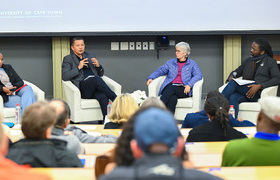
This question will sit at the heart of the second annual Wellbeing and Flourishing Conference at the University of Cape Town (UCT), which will take place on Friday, 30 October, at the New Lecture Theatre on upper campus. The event will bring together researchers, practitioners, students and university leaders to explore flourishing across individual, relational, institutional and societal life. Convened by UCT’s Centre for Wellbeing and Flourishing, the conference takes place under the theme “Flourishing Within and Beyond Fractures: Possibility, Connection and Well-being in a Changing World”.
A year after UCT’s inaugural conference established an interdisciplinary platform for conversations about well-being and flourishing, the second gathering asks a wider question: What conditions allow human possibility to remain open – particularly within contexts marked by inequality, uncertainty and change?
From human transformation to the Africa we want
A keynote address by Professor Shadrick Mazaza, honorary associate professor at UCT, will locate this conversation within a wider African horizon
Professor Mazaza is a physician, philosopher and researcher whose work connects human transformation, leadership and health with the development of the African continent. UCT describes his work through the African Consciousness Institute as being concerned with personal transformation and the maximisation of human potential as essential to Africa’s development and integration
“Transformation understood as a humanising praxis can create a sense of belonging, connect with ourselves and others, and share the gifts that we have.”
That intellectual trajectory has a particular resonance with the African Union’s Agenda 2063: The Africa We Want. Agenda 2063 imagines an integrated, prosperous and peaceful Africa driven by its own citizens and includes among its ambitions, quality of life and well-being for all
Mazaza’s keynote consequently opens a significant question for the gathering: What is the relationship between the transformation of people and the transformation of the societies they are being called upon to create?
It is a question that moves flourishing beyond an individual concern and into the terrain of participation, leadership, institutions and collective possibility
Belonging, humanity and the role of the university
The conference will culminate with closing reflections from Professor Elelwani Ramugondo, UCT’s deputy vice-chancellor for People, Culture and Society, providing an important institutional bookend to the day
Professor Ramugondo has previously argued that transformation understood as a humanising praxis can create “a sense of belonging, connect with ourselves and others, and share the gifts that we have”.
That perspective carries particular significance for a conference concerned with flourishing amid fracture
Her closing reflections will therefore bring a conversation extending outward towards African futures back to the university itself: What kinds of institutional environments enable people to belong, contribute and develop their possibilities?
From flourishing to flourishability
It is here that Sean Abrahams, the strategic founding lead of the Centre for Wellbeing and Flourishing and co-chair of the conference alongside Associate Professor Anita Campbell, introduces a further distinction
For Abrahams, the question is not only whether flourishing is currently visible, but whether the possibilities upon which future flourishing depends remain
“Flourishing asks what is being realised. Flourishability asks what remains
The distinction turns attention from outcomes alone towards the conditions from which those outcomes become possible
“Before flourishing can be achieved, sustained, or restored, it must remain possible.”
A student might be succeeding academically while the financial, relational or institutional conditions supporting that success are becoming increasingly fragile. Conversely, someone experiencing a period of difficulty may retain considerable future possibility where meaningful relationships, support, access and credible pathways forward remain available
For Abrahams, this leads to a deceptively simple proposition: “Before flourishing can be achieved, sustained, or restored, it must remain possible.”
That proposition brings the strands of the conference together
If Agenda 2063 articulates something of the Africa we want, flourishing asks what is being realised in people’s lives today. Flourishability asks whether the conditions remainbecomes possible tomorrow
And within the context of a university, that raises an equally important question: not only how well students and staff are doing now, but whether the environments surrounding them are widening or narrowing their meaningful possibilities for becoming
Flourishing within and beyond fractures
This is why the wording of this year’s theme is deliberate. To speak of flourishing within and beyond fractures is not to suggest that difficulty, inequality or institutional constraint can simply be overcome through individual positivity
The conference therefore brings together perspectives from higher education, psychology, health, education, leadership, organisational life, sustainability, community engagement and student development to consider human flourishing from multiple vantage points
Contributions will include empirical research, conceptual work, practice-based innovation and reflective perspectives, creating a space in which established approaches can meet emerging questions about belonging, possibility, participation and the environments people inhabit
Submit an abstract or register as a presenter
Abstract submission deadline: 1 September 2026
Notification of outcomes: 8 September 2026
Register to attend
 This work is licensed under a Creative Commons Attribution-NoDerivatives 4.0 <a href="https://healthylife7.com/third-international-dialogue-on-sustainable-financing-for-ncds-and-mental-health/” title=”Third International Dialogue on Sustainable Financing for NCDs and Mental Health”>International License.
Please view the republishing articles page for more information
Most read
Prenatal stress may alter brain networks that regulate children’s emotions10:05, 5 August 2026
UCT researcher earns prestigious global science grant14:05, 12 August 2026
New unit a shot in the arm for healthcare research in Africa13:00, 7 August 2026
Dr Kenneth Hughes (1945–2026)14:00, 5 August 2026
From discovery to impact: UCT showcase reimagines the postdoctoral journey14:00, 30 July 2026
Latest articles

What must remain possible for Africa to flourish?The second annual Wellbeing and Flourishing Conference will take place on 30 October.19 Aug 2026

Study identifies gaps between gender identity and the healthcare systemA study by UCT and the Desmond Tutu Health Foundation within the LGBTQI+ community has highlighted significant barriers to gender-affirming care despite critical need.18 Aug 2026

MSc inspires student entrepreneur to grow businessVuyo Hlongwane has used his MSc in Chemical Engineering to add a new arm to his existing business model.18 Aug 2026

Proof that biomedical research can be sustainableThe Institute of Infectious Disease and Molecular Medicine celebrates two years of major sustainability achievements under the Sustainable Science Initiative.18 Aug 2026

Why good data is the foundation for all HEMIS decisionsThe higher learning community gathered for the 2026 SAAIR HEMIS Institute hosted by UCT at the Graduate School of Business.18 Aug 2026
Related

News
UCT Flourish Lab: AI and human flourishing25 Mar 2026

News
UCT launches Centre for Wellbeing and Flourishing23 Sep 2025

News
UCT unveils Flourishing Community Showcase after groundbreaking summit07 Aug 2025
Research and innovation
Reimagining health systems for wellbeing – a Collective Conversation18 Jul 2025
TOP
