


Whatever happened to … children infected with HIV due to failures in healthcare?
September 2, 20267:58 AM ET
Text and photos by Betsy Joles
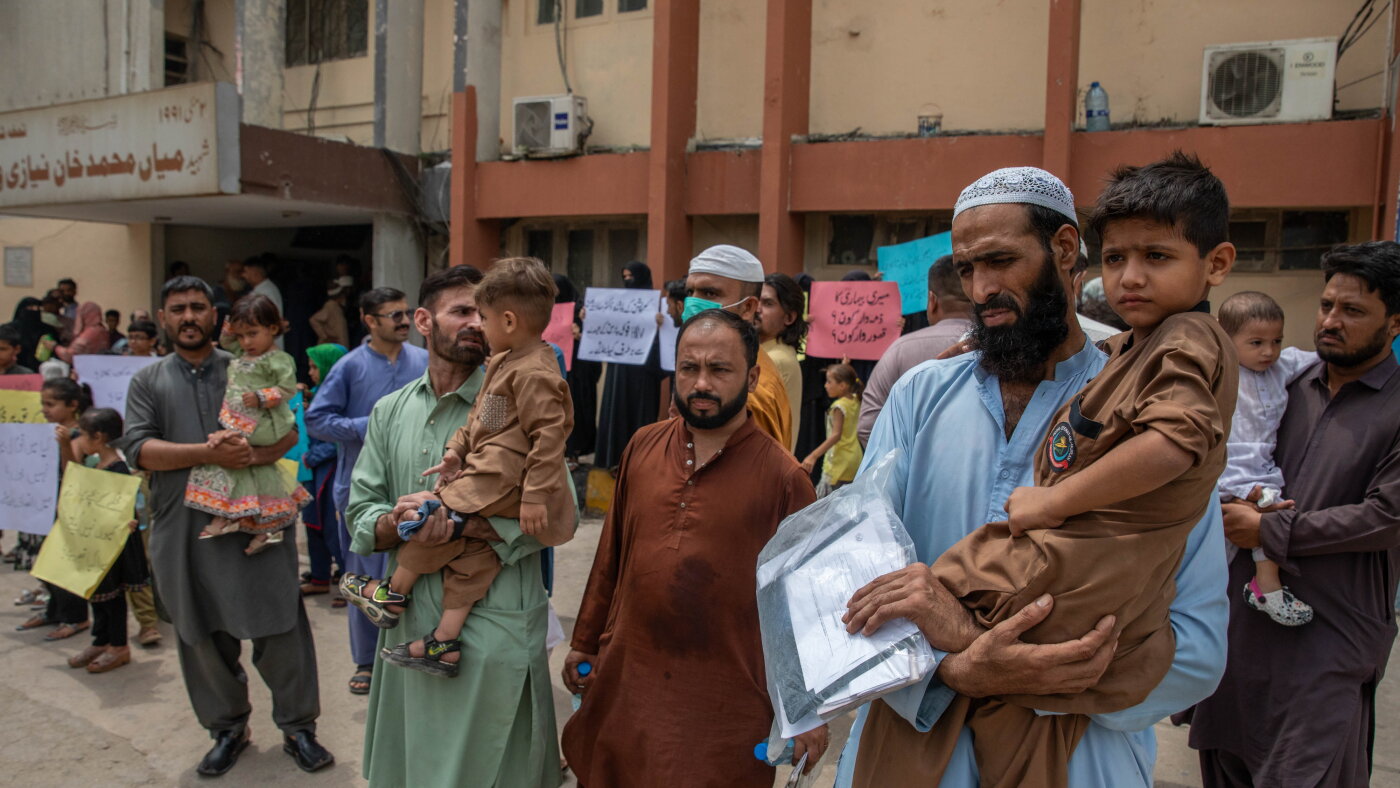
Parents of children who tested positive for HIV after receiving care at Kulsum Bai Valika Hospital in Karachi, Pakistan, held a protest there on July 23. These families received care at Valika Hospital through an aid program run by the labor ministry. Many of the parents of children infected with HIV are low-income factory workers.
Betsy Joles for NPRhide caption
toggle caption
Betsy Joles for NPR
Seven years ago, Pakistan faced a startling medical tragedy. In the city of Larkana, in Sindh province, 494 children were diagnosed with HIV. Authorities were puzzled but eventually determined a leading cause. As NPR reported at the time: “the tragedy is … being linked to major failures in the health care system, including reuse of syringes and lack of standards for blood transfusions.” The public was in an uproar. “There was panic, hue and cry,” Masood Bangash, a district police officer, told NPR. Parents gathered outside clinics in Larkana to express their anger. The government pledged action, including a crackdown on unauthorized medical providers,to prevent more such infections.
About This Series
Over the next week, we’ll be looking back at some of our global health and development stories to see “whatever happened to …”
This year, HIV cases amongchildren areagain being linked to unsafe medical practices. Here is a report from journalist Betsy Joles in Pakistan on the families affected –- andwhy the number of infections continues to risein a country with an estimated 350,000 active HIV cases, according to the World Health Organization, and a surge among youngsters. This story is the first in our annual series, “Whatever happened to …”
Goats and Soda
Medical Investigation: How Did 494 Children In 1 Pakistani City Get HIV?
KARACHI — In August 2025, Ayesha Aftab took two of her four children to Kulsoom Bai Valika Hospital in Karachi for treatment for what she suspected was typhoid or malaria — diseases most common during Pakistan’s muggy monsoon season in late summer. She brought along her youngest, Muhammad Rehan, as well. The toddler sat on her lap while her other kids received treatment and spiked a fever while they waited. The doctor on duty suggested an antibiotic injection to knock out his symptoms faster than a pill or over-the-counter syrup. “I thought, okay, the doctor knows better,” Aftab said.
In the crowded ward, she saw hospital staff giving injections to child after child. Their methods were common practice, they insisted to Aftab, even in well-known hospitals in the city. “We had never been to these hospitals,” she said, “so we thought maybe things happened this way.”
But Rehan’s health did not improve after the injection and Aftab’s other two children remained ill even after weeks of treatment
Laboratory tests provided a startling explanation: All three had contracted HIV, the bloodborne infection that causes AIDS and can be deadly if not treated quickly with the right mix of medicines
Dozens of other parents who brought their children to government-run Valika Hospital say their kids got HIV after being treated there too.At least six later died. They blame the reuse of syringes and IV needles at the hospital — echoing some findings from the 2019 outbreak
Multiple government-ordered inquiries since last November have noted safety issues at Valika Hospital, including improper handling of syringes. The department that manages the hospital suspended some staff, and the provincial government promised families financial compensation
Parents and children wait for care at Kulsum Bai Valika Hospital on July 25 in Karachi, Pakistan. Families say their children tested positive for HIV after syringes were used on multiple children being treated for other illnesses.
Betsy Joles for NPRhide caption
toggle caption
Betsy Joles for NPR
This outbreak came closely on the heels of another one in Taunsa, a district in Punjab province around 600 miles from Karachi, linked to medical care: 331 children infected with HIV between November 2024 and October 2025, prompting more government pledges to control the spread of the virus
Why does this keep happening?
So why does the issue of unsafe medical practices leading to pediatric HIV keep resurfacing?
Doctors interviewed for this story say past measures have been stopgap solutions -– for example, cracking down on unregistered clinics in Taunsa and suspending a local hospital superintendent. But they note that the government has not addressed deeper systemic shortcomings when it comes to medical safety in Pakistan
Fatima Mir, pediatric infectious disease specialist at the Aga Khan University Hospital in Karachi, says there remain significant “chinks in the armor” of Pakistan’s healthcare system that create the conditions for more cases of pediatric HIV to occur
They include persistently poor injection practices, along with unregulated blood donation services and reliance on informally trained providers in some areas, particularly rural ones where other options for care can be limited
Mir says recurring outbreaks flagged among children are actually “bridging events” where the virus moves from high-risk populations (including injectable drug users, sex workers, transgender people and men who have sex with men) to low-risk groups. Healthcare facilities act as the conduit because of poor standards for safe care. “Infection prevention and control is actually the emergency right now,” she says
These problems are part of a larger issue: Pakistan has one of the lowest rates of healthcare spending per capita in the region andmany of its public sector hospitals suffer from short-staffing (which could mean leaning on employees without sufficient training) and inadequate supervision to ensure safe practices
Through the years, pediatric HIV cases have been linked to both public and private healthcare providers, where quality varies widely and government oversight is inconsistent,says Syed Faisal Mahmood, who specializes in infection prevention, also at AKUH in Karachi. “Healthcare in general is now driven not by quality but by convenience and by cost,” Mahmood says, making it a “perfect storm” for unsafe medical practices.
During a speech to parliament in June, health minister Mustafa Kamal acknowledged “the wrong use of syringes” and IV drips as contributing factors in incidents of HIV
The pediatric outbreaks that get flagged don’t reflect the true gravity of the HIV crisis, public health experts warn
“Since our disease surveillance system is also very weak, we will never know what exactly the prevalence is,” says Zafar Mirza, Pakistan’s former special assistant to the prime minister on health. He says this makes the spread of HIV “much larger than what we know.”
What the children face
For kids who have contracted the disease, there’s a lifetime of daily pills ahead –- and deep societal prejudice. In many people’s minds, HIV and AIDS carry “back-breaking shame,” says Zulfikar Ali Bhutto Jr., a prominent activist who launched an awareness campaign about HIV in Pakistan this year. That’s because many associate them with sex — one way the virus can spread — and other socially frowned-upon activities like drug use
Zulfikar Ali Bhutto Jr. (left), who launched an awareness campaign about HIV and AIDS in Pakistan this year, conducts HIV tests alongside workers from the Humraz Male Health Society at a bus terminal in Karachi, Pakistan. Experts say hospitals have become vectors for the spread of HIV from high-risk groups (including people who inject drugs, men who have sex with men, and sex workers) to low-risk groups, notably children, through unsafe medical practice such as the reuse of syringes.
Betsy Joles for NPRhide caption
toggle caption
Betsy Joles for NPR
His campaign is trying to stamp out the stigma that surrounds an HIV diagnosisand educate people about the basics, such as how the virus can’t be spread through touching or sharing food
For now, families say their children have to manage the judgement that comes with HIV, which can translate to discrimination against them and their siblings
Muhammad Asif, a factory worker in Karachi, says his daughter Manahil was refused admission to school because of her HIV diagnosis. Three of his other daughters were also denied admission despite being HIV free. The cost of books and school supplies for a new school is another thing to manage on his $140 monthly salary
Muhammad Asif, whose children Muhammad Yaseen and Manahil tested postiive for HIV after receiving care from Valika Hospital, sits in his home on July 25 in Karachi, Pakistan. Asif’s children were diagnosed with HIV after seeking treatment at Valika Hospital for a fever. “Yaseen is too young to understand. I don’t know what he will think: that his father brought him to this hospital and he contracted such a fatal illness,” Asif says.
Betsy Joles for NPRhide caption
toggle caption
Betsy Joles for NPR
“We have to spend money on our sick children and take them to hospitals far away. We either have to pay for transport or spend money on their schooling,” Asif says
Umaima Ansari, a teacher in Hyderabad, has experienced how the stigma that comes with HIV feels since her 3-year-old son Hussain tested positive
His family suspects an operation soon after birth to treat hydrocephalus, which causes swelling in the brain, or a blood transfusion just over a year later may have carried the virus
Following Hussain’s diagnosis, Ansari says both public and private hospitals started turning him away, saying they would not be able to treat him for his other medical conditions because of the risk
Umaima Ansari, whose 3-year-old son Hussain tested positive for HIV after an operation to address complications related to hydrocephalus, walks near her home with her children in Hyderabad, Pakistan. Ansari says multiple healthcare providers refused to treat her son, who also has cerebral palsy, after learning about his HIV diagnosis.
Betsy Joles for NPRhide caption
toggle caption
Betsy Joles for NPR
Even physiotherapists for management of his cerebral palsy, a diagnosis he also received shortly after birth, became wary. Ansari was advised early on by other medical providers to keep Hussain’s diagnosis private. “Don’t tell anyone he has HIV. People will stop meeting you. People will stop coming over to your house,” she recalls being told
What does the future hold?
The looming question: Will the government’s new safety measures reduce the risk of medical HIV transmission?
So far, these measures include nationwide HIV screenings before surgeries to flag undetected infections, and a complete ban on certain types of syringes from January, a move that first started after the Larkana outbreak 7 years ago. The ban aims to replace conventional syringes with ones that lock, making them harder to reuse
As for kids who’ve already been diagnosed, the activist Bhutto says grace from society is key
“These children will have to live with this disease for the rest of their life as far as we know. So they need to live in a world that is kind to them.”
Betsy Joles is a journalist based in Pakistan
For stories about life in our changing world,subscribe to NPR’s Global Health newsletter
NPR does not offer or accept money for coverage or interviews.
Anyone who makes such an offer or request is not an NPR employee and does not represent NPR
- HIV
- HIV transmission
