


By Chuck Dinerstein, MD, MBA — Jul 24, 2026
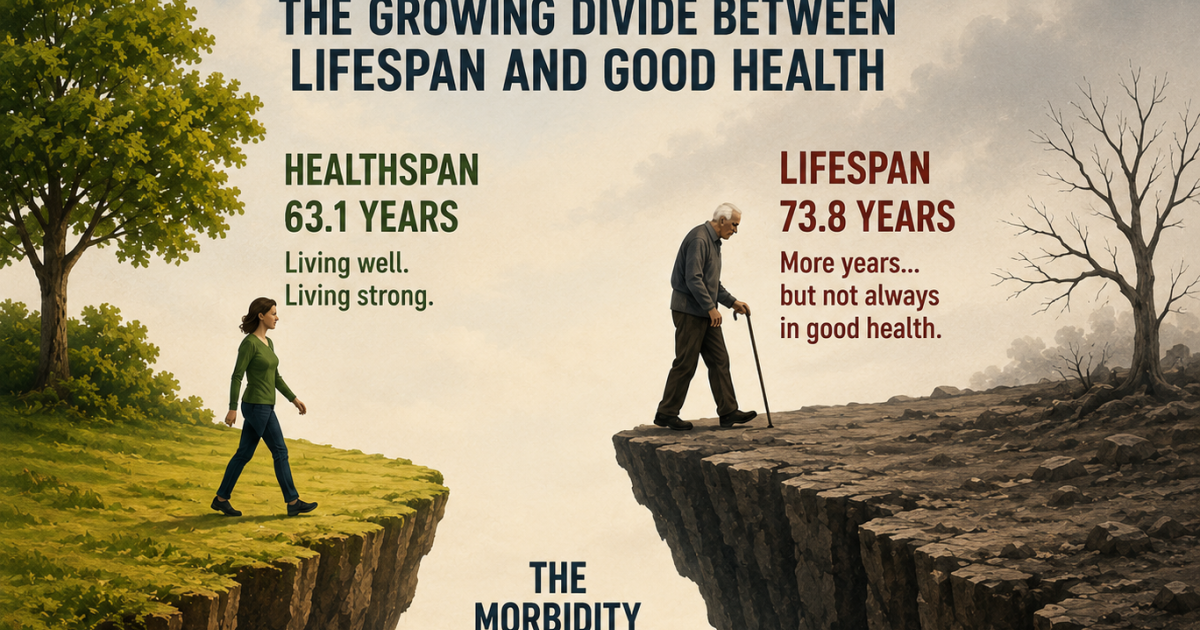
Over the past three decades, global advances in medicine have significantly extended human lifespan, but gains in healthy living have failed to keep pace. This imbalance has created a widening “morbidity gap,” where we spend over a decade in poor health. Will a shift in focus for healthcare systems make a difference?
Image: ACSH
As our lifespan increases, attention has focused on our healthspan – the time we spend living in good health. As a new articlein The Lancet points out, differential improvements in our lifespan and healthspan can lead to one of several outcomes:
- Ideally, disability is “compressed” into the very end of life, leaving us with the greatest proportion of healthy lifespan, a period termed the “morbidity gap” in this study.
- Advances in care result in greater survival gains at the cost of an increasing “morbidity gap,” as longer lives paradoxically carry higher risks of disabling conditions.
- As lifespan increases and more chronic medical conditions arise, those conditions are better managed, reducing the severity of the “morbidity gap” if not its length
The Lancet study argues that over the last 30 years or so, improvement in survival has outpaced reductions in non-fatal health loss globally.
- Between 1990 and 2023, global average life expectancy rose by 9.2 years to 73.8 years, while healthy life expectancy increased by only 7.2 years to 63.1 years. The resulting global “morbidity gap”—the absolute time spent in poor health—increased by about 20%, or nearly two years. This widening occurred in 203 of 204 countries and territories (99.5%), raising the global proportion of life spent in poor health from 13.6% in 1990 to 14.5% in 2023.
- Instead of our health losscompressinginto a brief period at the very end of life, disability builds progressively across the entire adult life course. Nonfatal health loss expands steadily across every adult age bracket rather than being confined to advanced age.
- That expanding morbidity gap is largely driven by chronic conditions, with five major cause groups accounting for nearly 60% of our unhealthy years globally. The top two are musculoskeletal disorders, primarily low back pain, and depression and anxiety, which steal 1.8 and 1.6 years of health from our lives, respectively. Age-related hearing and sight loss, along with unintentional injuries, i.e., falls, round out the top four.
- Women, who consistently outlive men, also experience a large absolute and proportional duration of chronic illness, nearly 16% of their lifespan compared to 13% for males.
The Development Paradox
Highly developed nations successfully avert premature deaths, but their populations end up enduring a longer overall duration of chronic illness. The largest morbidity gap was found in the High Socio-demographic Index (SDI) nations; the SDI is a composite score of fertility for females under 25, mean educational attainment for those age 15 or older, and distributed income per capita. The United States had the greatest morbidity gap at 14 years, while the countries of sub-Saharan Africa had the smallest.
Do we want to be more like sub-Saharan Africa and other countries with a low SDI? Not so clearly. While the gap between being healthy and dying is smaller, that may well reflect health systems geared primarily to acute rather than chronic illness.
Is the US morbidity gap, the largest globally, a good thing? As with the previous response, not necessarily. We have a health system that is very good at treating acute illness and preventing deaths – but that advantage comes with inevitable downstream consequences. Consider, for example, breast cancer. In the 1980s, the overall 20-year survival rate was about 40 to 45%. Today, that survival rate has doubled. Breast cancer survivors can experience increased cardiovascular risk due to chemotherapy and radiation, while treatment-induced menopause shifts their metabolism, resulting in central weight gain and muscle loss. There can also be nerve damage and a less well-defined chemo-brain fog. Earlier generations rarely survived long enough for these issues to surface; medicine is now navigating the morbidity gap associated with long-term survivorship, which includes specific long-term effects as well as the general debility that comes with aging.
Individual Responsibility or Public Health
Those more general factors, which the authors note account for much of our unhealthy years, vary with the usual demographics, cultural differences, and geography.
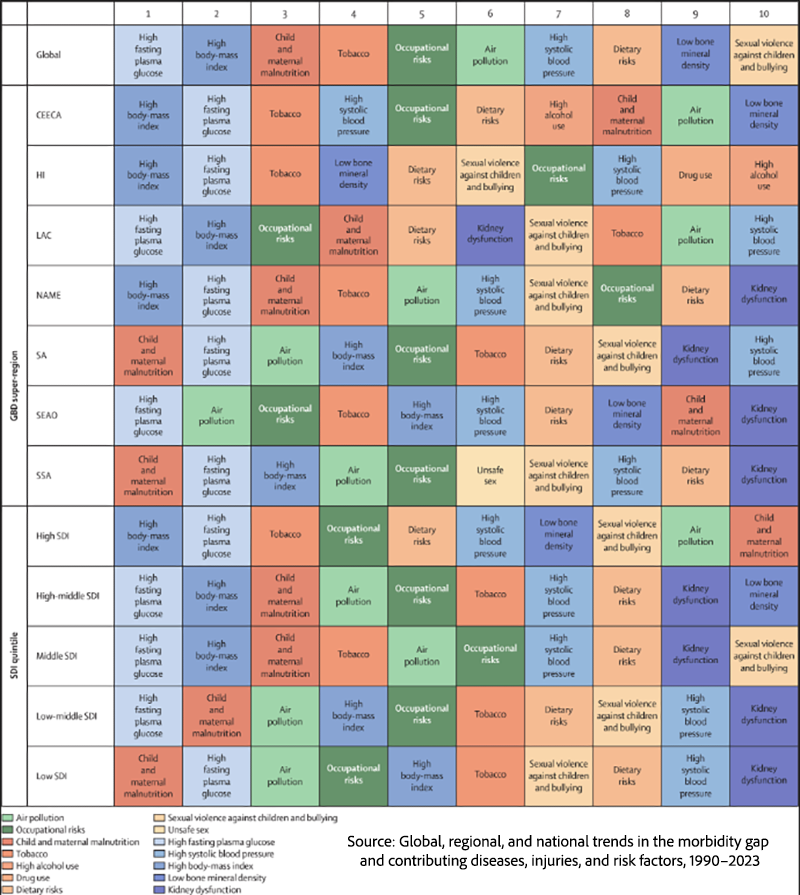
As can be seen, the US’s biggest contributors to our morbidity gap are our relationship with food, tobacco use, and occupational risk. Of the top five, 4 are within our immediate control and do not require any greater intervention from our health systems than a reminder about diet, exercise, and not smoking. Of course, those all require an individual level of responsibility, aided by an occasional prescription. As a physician and fellow human, I can attest to the difficulty in changing behavior.
“Progress in healthy aging should be measured not only by lifespan, but by healthspan, with greater investment in prevention, long-term disease management, and chronic care to reduce years lived in poor health.”
– Dr. Christopher Murray, senior author and Director of the Institute for Health Metrics and Evaluation (IHME) at the University of Washington School of Medicine
It is unclear how we might do better at preventing hearing and sight loss, but our healthcare system can identify needs, and our social service structure can provide mitigation through hearing aids, treatment for cataracts and glaucoma, and adaptive visual aids, i.e., audiobooks and large-print editions. We can predict falls but rarely alter the home environment to provide the necessary infrastructure adaptations, i.e., ramps, handrails, ambient lighting. The loneliness of aging, with its attendant depression and anxiety, can be identified by our physicians, but the solutions lie with our families and social structures that can replace generational households that no longer exist.
Extending human life without protecting functional well-being represents a bittersweet triumph for modern medicine. As survival gains continue to convert acute fatal events into long-term chronic conditions, public health performance can no longer be measured by solely by longevity. Healthy aging will not come solely from pills and potions; it requires individuals to manage controllable lifestyle risks and for societies to find ways to “strengthen the feeble hands, steady the knees that give way.” That will require more than a shifting focus by healthcare systems.
nd contributing diseases, injuries, and risk factors, 1990–2023: a systematic analysis for the Global Burden of Disease Study 2023 The Lancet DOI: 10.1016/S2468-2667(26)00098-8
Tags:
Category
Disease
Chuck Dinerstein, MD, MBA
Director of Medicine
Dr. Charles Dinerstein, M.D., MBA, FACS is Director of Medicine at the American Council on Science and Health. He has over 25 years of experience as a vascular surgeon
Recent articles by this author:
Mind the Gap: The growing divide between lifespan and good health
Have It Your Way: Beyond the Burger King Ingredient Scare
Every Hit Counts: The new science behind football and dementia
What Senator Graham’s aortic dissection can teach us about heart disease
The science of sponge anxiety
All articles by this author
