


Key points
- One of the hallmarks of Alzheimer’s disease is the accumulation of a peptide in the brain called amyloid beta.
- There is an intermediate state of amyloid beta that exists between its healthy version and the large plaques it forms in Alzheimer’s disease.
- Researchers have now identified the structure of this intermediate state, which could open new, more effective options for treating the disease.
One of the hallmarks of Alzheimer’s disease is the accumulation of a peptide in the brain known as amyloid beta. A new Nature Communications study published July 22 has uncovered the atomic structure of the peptide when it’s damaging to the brain
Amyloid beta is a naturally occurring peptide that exists in healthy brains. But in Alzheimer’s disease, these peptides clump together abnormally and form large plaques. Scientists have known about the association between these plaques and Alzheimer’s disease for over a century, but whether this buildup is actually damaging the brain or simply a byproduct of the disease has been hotly debated
There is also an intermediate state of amyloid beta that exists between the healthy peptides and the large plaques. Emerging evidence suggests that it is these intermediates—so called “oligomeric” amyloid beta—that are the drivers of damage to the brain, but their structure has remained unknown. Now, a team of researchers at Yale School of Medicine has characterized this intermediate form for the first time
“This intermediate state—the ‘oligomeric’ state—is the one that’s likely actually causing the damage to the brain, but we haven’t known exactly what it is, and therefore we haven’t been able to figure out the best way to target it with drugs in a specific manner.”
Over the last couple of years, the U.S. Food and Drug Administration (FDA) has approved two therapies that reduce the amount of amyloid beta in the brain, but their benefits are limited, and they can cause severe side effects. The findings could inform new therapies that target the harmful forms of amyloid beta while preserving non-pathogenic forms, the scientists say
“This intermediate state—the ‘oligomeric’ state—is the one that’s likely actually causing the damage to the brain, but we haven’t known exactly what it is, and therefore we haven’t been able to figure out the best way to target it with drugs in a specific manner,” says Stephen Strittmatter, MD, PhD, Vincent Coates Professor of Neurology, chair of the Department of Neuroscience at Yale School of Medicine, and the study’s principal investigator
Revealing oligomeric amyloid beta structure
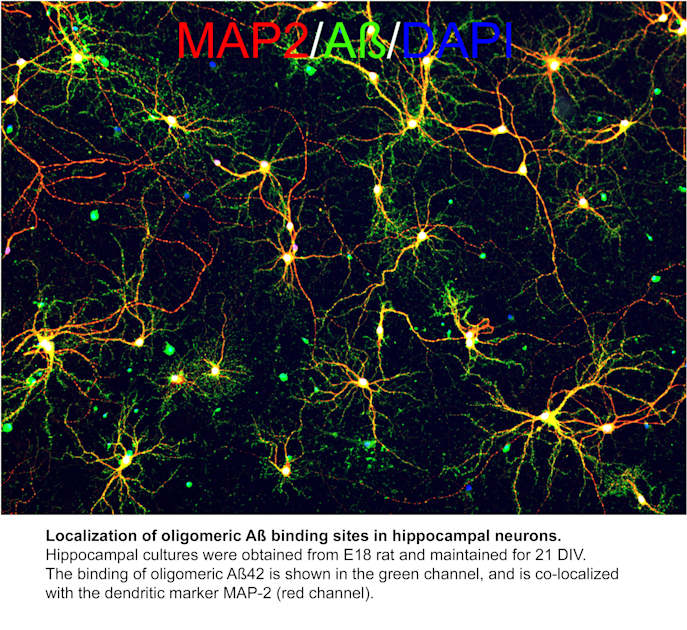
Over the last decade, Strittmatter’s team has been studying the receptors on neurons that interact with “oligomeric” amyloid beta. Through this work, they have discovered that those receptors bind very tightly to the peptides. As a result, scientists have struggled to characterize the structure of oligomeric amyloid beta because the peptides are difficult to remove from these receptors and there’s very little non-bound oligomeric amyloid beta in the brain
To overcome this challenge, Strittmatter’s team treated human brain tissue affected by Alzheimer’s disease with a drug that could displace “oligomeric” amyloid beta from receptors. Then, they purified the toxic peptide from its other forms. When the researchers took the purified oligomeric peptides and added it to cultured human neurons, the cells became damaged, proving that they were still biologically active
Then, they used several microscopy methods to visualize the structure of the peptide. Unlike plaque amyloid beta, which exists as long filaments thousands of nanometers long, “oligomeric” amyloid beta is composed of short rods of about 65 nanometers. While similar in structure to plaques, they identified key differences in the ways groups of atoms were arranged. Thus, the toxic receptor-bound “oligomers” were in fact short filaments different from the plaque amyloid beta
“They have a unique, distinct structure,” Strittmatter says
They also discovered that “oligomeric” amyloid beta could stimulate the formation of more toxic peptides. “Polymerization is biased against long filaments,” Strittmatter says
“Now that we have atomic resolution on the bad stuff in the Alzheimer’s brain, we hope that will lead to new ways to treat the disease.”
In 2023, the FDA approved lecanemab (Leqembi) as the first anti-amyloid beta therapy for the treatment of Alzheimer’s disease. The following year, they approved a second drug named donanemab (Kisunla). However, these drugs only slow the disease by about 30% and can cause serious side effects including inflammation and bleeding in the brain. These antibodies target both the plaque amyloid beta and the “oligomeric” amyloid beta, but their toxicities likely result from clearance of the plaque form.
“Now that we have atomic resolution on the bad stuff in the Alzheimer’s brain, we hope that will lead to new ways to treat the disease,” Strittmatter says
Mikhail Kostylev, PhD; Carmen Butan, PhD; Graham Roseman, PhD; and Pallavi Gopal, MD, PhD, all contributed to the study
Article outro
Author
The research reported in this news article was supported by the National Institutes of Health (awards R01AG034924, RF1AG070926, P30AG066508, and T32NS105583) and Yale University. The content is solely the responsibility of the authors and does not necessarily represent the official views of the National Institutes of Health
