



It happens to the best of us: You’ve been consistent in the gym, you’re noticing gains, and then life throws you a curveball. Maybe you get sick, injured, or you’re just logging long hours at the office. Whatever the case, your gym routine is thrown out of whack and now you’re worried about losing the muscle mass you’ve built up.
First, some good news: Taking a few weeks off of exercising won’t affect the average fitness enthusiast too much, says personal trainer Cara D’Orazio, C.P.T. and owner of C.G.M. Fitness, Inc., a virtual training studio. If you’re inactive for four to six weeks, that’s when you’ll start noticing a decrease in muscle mass, she says
“It also depends on fitness levels and overall health,” D’Orazio says. “For example, an athlete who trains four to five times a week may not lose strength as quickly as someone who is new to working out or who isn’t as consistent,” D’Orazio says.
Advertisement
Here’s some tips from trainers and a nutritionist to help you preserve muscle mass when your workout routine is thrown off schedule.
1. Re-adjust your protein intake

Extra protein is needed for building and repairing muscle tissue after strenuous workouts, but if you eat more protein than you need when not working out, your body will store those extra calories as fat, says dietitian Sheri Berger, RDN, from The Plant Strong Dietitian
If you’re absent from the gym, you may need to scale down on your protein intake. For sedentary adults, the recommended dietary allowance (RDA) for protein is 0.8 multiplied by your weight in kilograms, which will give the number of grams of protein needed in a day, says Berger. An easier way to calculate the RDA for protein, though, is to multiply 0.36 by your weight in pounds, she says.
A simple way to get the right nutrients is by choosing balanced meals, and making half the meal vegetables and fruit, a quarter of the meal protein such as poultry, fish, beef, pork, beans, or tofu, and a quarter of the meal a grain or starchy vegetable such as potatoes or corn, Berger says
Advertisement
Of course, if you’re taking some time off from your gym routine, you still need to prioritize protein, points out strength and conditioning coach Mike Hamlin, C.S.C.S., founder of Everflex Fitness. He points to a study published in the Annals of the New York Academy of Sciences that found inactive, hospitalized older adults benefited from supplementing with 30 grams of protein because it helped them maintain muscle
If you’re out of the gym for a prolonged period, consider consulting with a dietitian to help you adjust your macros
2. Focus on heavy resistance training and compound movements

If you’re still able to workout (but just not as much as normal!), focus on resistance training, suggests Hamlin
“A great way to increase the chance of maintaining muscle while training less is to increase your intensity―i.e. adding more weight,” he says.
Advertisement
He suggests lifting with heavier dumbbells and kettlebells that can be used while on vacation since they’re in most hotel gyms and that you can have at your house, too. Shoot for reps in the 6-to-10 range, he says
“Just make sure that you get a really high-quality warm-up as these higher-intensity workouts are a bit riskier in terms of injury prevention,” Hamlin says.
Also, working out at a high intensity for a prolonged period (for a month or longer) could lead to chronic injuries, he cautions
Another way to maximize your time in the gym is to focus on compound movements as they’ll reduce the time you spend working out, Hamlin says.
Advertisement
“If you isolate every body part you end up working out for longer,” he says. “Go heavier and use compound movements to shorten the amount of time in the gym and increase your ability to maintain mass throughout the week when you aren’t training.”
3. Prioritize recovery
When you’re out of your lifting routine, it’s important to focus on active recovery and mobility work, says personal trainer Mike Julom, C.P.T. and founder of This is Why I’m Fit.
Giving your muscles a chance to recover with light, active movements—like gentle yoga, walking and dynamic stretches (i.e. those that require movement like a torso twist)—can help maintain muscle tissue, Julom explains. These movements help increase blood flow to the muscles, delivering essential nutrients that aid in repair and muscle maintenance, he says. Active recovery can also keep your joints flexible so when you do return to your regular workout routine, you’ll reduce the risk of injury, Julom says.
You’ll also want to get enough ZZZ’s since muscles grow and repair during rest, Hamlin says.
Advertisement
“Aim for seven to nine hours of quality sleep per night and practice relaxation techniques like meditation to minimize stress,” he says
4. Use resistance bands
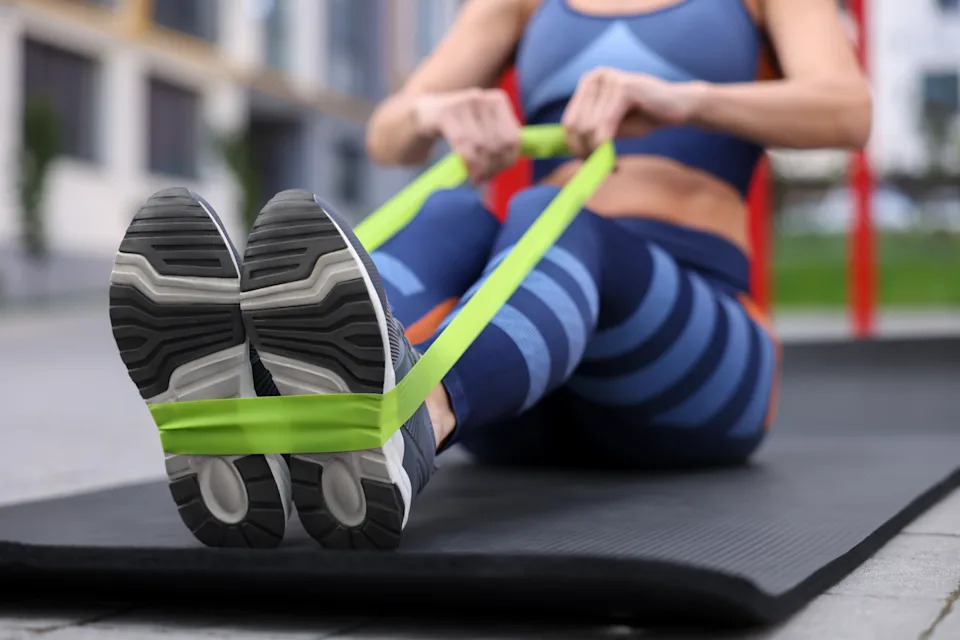
The beauty of resistance bands is they’re easy to use, can be tremendously effective and are portable, which can help you get in a quick workout even if you can’t make it to the gym, Julom says
“It’s a convenient piece of equipment that you can take with you just about anywhere, and regularly using it can help you maintain muscle mass,” he says
Exercises like bicep curls, squats, lateral raises, and chest presses can go a long way in helping you to maintain muscle mass, Julom says

Brittany Anas Creator
Brittany Anas is an award-winning journalist covering all the sweet things in life, from travel to home to food and beverage. She is based in Denver, Colorado.
Creators are not employed by Yahoo. Views expressed by creators do not reflect the opinions and position of Yahoo.Learn how to become a creator.
