


Download PDF
Subjects
- Gene therapy
- Molecular medicine
A recent study published in Nature by Jiang et al. delineates a breakthrough in the treatment of inherited hearing loss through gene therapy.1 This study offers the most compelling clinical evidence so far that gene replacement therapy can safely restore significant hearing in children with OTOF-related deafness, with benefits lasting up to 2.5 years, setting a new standard for treating inherited sensory disorders
The bespoke cell and gene therapy approach is revolutionizing precision medicine for genetically diverse diseases. The OTOF gene encodes otoferlin, a transmembrane protein involved in signal transduction that functions as a calcium sensor for synaptic vesicle fusion within the inner hair cells of the cochlea. This gene was linked to hereditary deafness in 1999 by Christine Petit’s group.2 Here, in pediatric patients with autosomal recessive deafness caused by OTOF mutations, dual adeno-associated virus (AAV)–mediated delivery of the OTOF transgene was developed.3 As the OTOF gene’s coding sequence exceeds the packaging capacity of a single AAV vector, the study employed a dual-AAV1 vector strategy to reconstitute the full-length OTOF coding sequence under the control of a Myo15 promoter in vivo following cochlear delivery.3 In the earlier reported clinical trial, about 75% of children met both behavioral pure-tone audiometry (PTA) and auditory brainstem response (ABR) criteria.3
Across multiple clinical centers, treated children demonstrated substantial and durable improvements in auditory function, including the restoration of ABRs, enhanced speech perception, and significant gains in sound detection and communication skills. Importantly, therapeutic benefits were observed relatively quickly after treatment and persisted during extended follow-up periods, indicating stable transgene expression and enduring cochlear rescue.1 Younger patients generally exhibited the most pronounced outcomes, underscoring the importance of early intervention before irreversible degeneration of the auditory pathways.
This study also reported encouraging safety data, with no major dose-limiting toxicities or severe adverse events directly attributable to the therapy.1 Collectively, this study represents a landmark proof of concept for inner ear gene therapy and demonstrates that sensory disorders caused by single-gene loss-of-function mutations can be functionally restored in humans.1 The recent FDA approval of the first-ever gene therapy treatment for genetic hearing loss under an accelerated pathway, along with the use of a national priority voucher, raises major hopes. This supports Regeneron’s decision to offer Otarmeni® free in the USA, likely for a small number of patients annually. Most with inherited deafness lack access to gene-specific treatments (Fig. 1). Cochlear implantation remains the standard of care, underscoring the need for scalable therapies to treat larger populations with genetic hearing disorders.
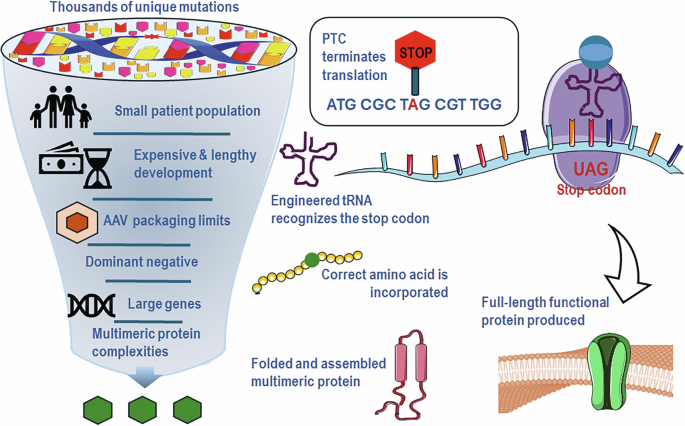
Gene-agnostic one platform, many mutations for broad applicability. The left side shows thousands of unique mutations in the double-stranded DNA that cause rare genetic diseases, often hindered by small patient populations, costly development, AAV limitations, dominant-negative effects, large genes, and complex multimeric proteins. This restricts treatment to a few studies with persistent results. On the right is our illustration of the many disorders arising from premature termination codons (PTCs), which halt protein translation. The schematic shows ACE-tRNA viral delivery, in which a suppressor tRNA recognizes the UAG stop codon and adds the correct amino acid during translation, allowing full-length functional protein production. A full-length protein with a functional ion channel shows promise for a “one-for-many” rare-disease therapeutic strategy. Parts of the figure art are based on artwork borrowed from SMART-Servier Medical ART
More broadly, this trial establishes a translational framework for treating inherited sensory disorders through AAV-mediated gene replacement, despite the challenges posed by large genes and delicate target tissues, such as the cochlea.1 The use of dual vectors has been proposed in several trials that are developing gene augmentation strategies to correct large gene defects. However, the likelihood of co-transduction of the same cells with both halves of the gene, the large size of genes beyond dual AAV packaging, vector recombination fidelity, manufacturing complexity, and variable protein reconstitution pose significant therapeutic bottlenecks.
Engineered suppressor transfer RNAs (ACE-tRNAs), on the other hand, offer a complementary and conceptually distinct solution by targeting translation rather than augmenting the gene itself. Instead of delivering full-length cDNAs, engineered tRNAs reprogram the ribosome to bypass premature stop codons and restore the synthesis of full-length endogenous proteins (Fig. 1). This strategy entirely bypasses gene-size limitations, as exemplified by OTOF, while preserving native transcriptional regulation, alternative isoforms, and genomic architecture. Viral delivery of ACE-tRNAs suggests that translational correction may evolve into a gene- and position-agnostic therapeutic platform for treating nonsense-mediated diseases.
Nonsense mutations comprise approximately 25% of pathogenic human variants, making translational rescue a promising therapeutic approach. Tryptophan nonsense mutations are particularly problematic. Tryptophan plays a crucial role in membrane proteins because of its aromatic and amphipathic nature, which stabilizes protein insertion, folding, and membrane anchoring. These residues are often found at membrane–water interfaces, helping to position transmembrane domains and maintain the structural integrity of channels, receptors, and transporters. Loss of a conserved tryptophan can disrupt assembly, trafficking, gating, and ion flow in ion channels and multimeric membrane proteins. Restoring the correct tryptophan via engineered translational repair is vital, as incorrect amino acid substitutions can impair native membrane topology and function. Engineered tRNA therapeutics can promote readthrough and test whether translational reprogramming can rebuild proper protein biogenesis.
The success of OTOF therapy reinforces a broader biological principle: sensory systems, both the ears and the eyes, that are relatively closed systems, can respond robustly to molecular rescue even after developmental impairment. This observation is particularly encouraging for emerging RNA-level interventions for inherited blindness and deafness. In retinal disease models, engineered tRNAs have already demonstrated the restoration of physiological ion-channel function in patient-derived retinal pigment epithelium and partial rescue of retinal electrophysiology in vivo. Together, these studies suggest that translational correction may complement gene augmentation and genome editing, rather than compete with them.
However, several hurdles must be overcome before engineered tRNA therapeutics can achieve widespread clinical translation. Readthrough efficiency remains context-dependent, delivery to post-mitotic tissues remains challenging, and long-term effects on translational homeostasis require careful evaluation. Nonetheless, the convergence of gene therapy, genome editing, and translational reprogramming signals a broader shift in precision medicine, from mutation-specific intervention to programmable correction of entire classes of pathogenic variants. As rare disease therapeutics move beyond replacement toward reengineering the flow of genetic information, engineered tRNAs may emerge as one of the most adaptable platforms in molecular medicine.
However, the rise of engineered transfer RNA (tRNA) therapeutics may signify a pivotal shift in the field of precision medicine, extending well beyond ophthalmology into a broad new category of gene- and position-agnostic molecular therapies. Initially driven by inherited retinal diseases—where immune privilege, accessibility, and sensitive functional readouts offered an ideal testing environment—engineered tRNAs are now increasingly recognized as adaptable biological tools capable of correcting premature termination codons across a variety of tissues and disease settings.4
Ophthalmology has proven that in inherited retinal channelopathies, anticodon-engineered tRNAs can restore protein production, improve electrophysiological responses, and enhance cellular health in patient-derived retinal pigment epithelium and preclinical models of the disease.5 Nonsense mutations are a major source of pathogenic human variations in neurology, cardiology, nephrology, pulmonology, metabolic diseases, and oncology. The molecular approach used to rescue retinal degeneration could be applied to conditions such as cystic fibrosis, Duchenne muscular dystrophy, lysosomal storage disorders, epileptic encephalopathies, inherited cardiomyopathies, and rare pediatric syndromes.
In many respects, sensory systems may be considered a starting point rather than a unique destination for engineered tRNA therapy
References
Jiang, L. et al. Multicentre gene therapy for OTOF-related deafness followed up to 2.5 years. Nature653, 1170–1177 (2026)
Yasunaga, S. et al. A mutation in OTOF, encoding otoferlin, a FER-1-like protein, causes DFNB9, a nonsyndromic form of deafness. Nat. Genet.21, 363–369 (1999)
Valayannopoulos, V. et al. DB-OTO gene therapy for inherited deafness. N. Engl. J. Med.394, 1074–1083 (2026)
Specht, C. et al. An engineered glutamic acid tRNA for efficient suppression of pathogenic nonsense mutations. Nucleic Acids Res.53, gkaf532 (2025)
Shahi, P. K. et al. Engineered tRNA reduces vision loss in a mouse model of Leber congenital amaurosis. Signal Transduct. Target. Ther.11, 225 (2026)
Acknowledgements
B.R.P. is supported by the National Institute of Health (grant numbers R01EY024995, R24EY032434, U19NS132296), the Retina Research Foundation, the Daniel M. Albert Chair in McPherson Eye Research Institute, and an unrestricted Grant from Research to Prevent Blindness, Inc. to the UW-Madison Department of Ophthalmology and Visual Sciences. J.A.S. is supported by the National Institute of Health (R01EY033049), the Eye and Ear Foundation of Pittsburgh, and an unrestricted grant from Research to Prevent Blindness, Inc. to the Department of Ophthalmology, University of Pittsburgh.
Author information
Authors and Affiliations
Department of Pediatrics, University of Wisconsin-Madison, Madison, WI, USA
Bikash R. Pattnaik
McPherson Eye Research Institute, University of Wisconsin-Madison, Madison, WI, USA
Bikash R. Pattnaik
Department of Ophthalmology and Visual Sciences, University of Wisconsin-Madison, Madison, WI, USA
Bikash R. Pattnaik
Department of Ophthalmology, School of Medicine, University of Pittsburgh, Pittsburgh, PA, USA
Jose A. Sahel
Authors
- Bikash R. PattnaikView author publications
Search author on:PubMed Google Scholar
- Jose A. SahelView author publications
Search author on:PubMed Google Scholar
Contributions
B.R.P. and J.A.S. conceptualized the framework and wrote the paper. B.R.P. generated the figure. All authors have read and approved this manuscript
Ethics declarations
Competing interests
The authors declare no competing interests. B.R.P. is a scientific co-founder and board member of Hubble Therapeutics. J.A.S. is an Inventor of NetraMind Innovations, Pixium Vision, GenSight Biologics, Sparing Vision, Prophesee, and Chronolife
Additional information
Publisher’s note Springer Nature remains neutral with regard to jurisdictional claims in published maps and institutional affiliations
Rights and permissions
Open Access This article is licensed under a Creative Commons Attribution-NonCommercial-NoDerivatives 4.0 International License, which permits any non-commercial use, sharing, distribution and reproduction in any medium or format, as long as you give appropriate credit to the original author(s) and the source, provide a link to the Creative Commons licence, and indicate if you modified the licensed material. You do not have permission under this licence to share adapted material derived from this article or parts of it. The images or other third party material in this article are included in the article’s Creative Commons licence, unless indicated otherwise in a credit line to the material. If material is not included in the article’s Creative Commons licence and your intended use is not permitted by statutory regulation or exceeds the permitted use, you will need to obtain permission directly from the copyright holder. To view a copy of this licence, visit http://creativecommons.org/licenses/by-nc-nd/4.0/.
About this article
Cite this article
Pattnaik, B.R., Sahel, J.A. Reprogramming translation for rare disease therapy: challenges posed by large genes.
Sig Transduct Target Ther11, 349 (2026). https://doi.org/10.1038/s41392-026-02942-8
Received:31 May 2026
Revised:21 June 2026
Accepted:07 July 2026
Published:26 August 2026
Version of record:26 August 2026
DOI
:https://doi.org/10.1038/s41392-026-02942-8
