Image
Aug. 31, 2026
Leaded ang health concerns, new study finds
Aug. 31, 2026
Story By
Alyssa Shiel, [email protected]; Dean Atkinson, [email protected]
CORVALLIS, Ore. – Emissions from aircraft that use leaded achers at Oregon State University and Portland State University has found
Lead levels were much higher near two Portland, Oregon-area regional airports than urban areas located farther away, and the dominantental geochemist at Oregon State University, and one of the study’s corresponding authors
“While lead was phased out of motor vehicle gasoline decades ago, piston-engine aircraft – small planes such as single-engine trainers, light twin-engine planes, agricultural crop-dusters and vintage war planes -remain the largest remainingssociate professor in OSU’s College of Earth, Ocean, and Atmospheric Sciences
Lead is a highly toxic metal. Children are particularly vulnerable to lead exposure, which can lead to developmental delays, difficulty learning and behavioral issues
Shiel has been studying heavy metal contaminants including lead for nearly a decade. She and Dean Atkinson, an atmospheric chemist and associate professor of chemistry at PSU, teamed up after they discovered they were both working on projects related to lead emissions at the Hillsboro, Oregon, airport
“Tracking airborne lead near general ading author of the paper. “Alyssa brought expertise in heavy metal isotopic fingerprinting, and my focus was on atmospheric measurements and air quality. Together, we found a practical, low-cost way to show exactly where lead emissions are settling in local neighborhoods.”
The findings were just published in the journal Nature Communications Sustainability. The study’s lead author is Oluwaseyi Aderinboye, a doctoral candidate and advisee of Atkinson at PSU
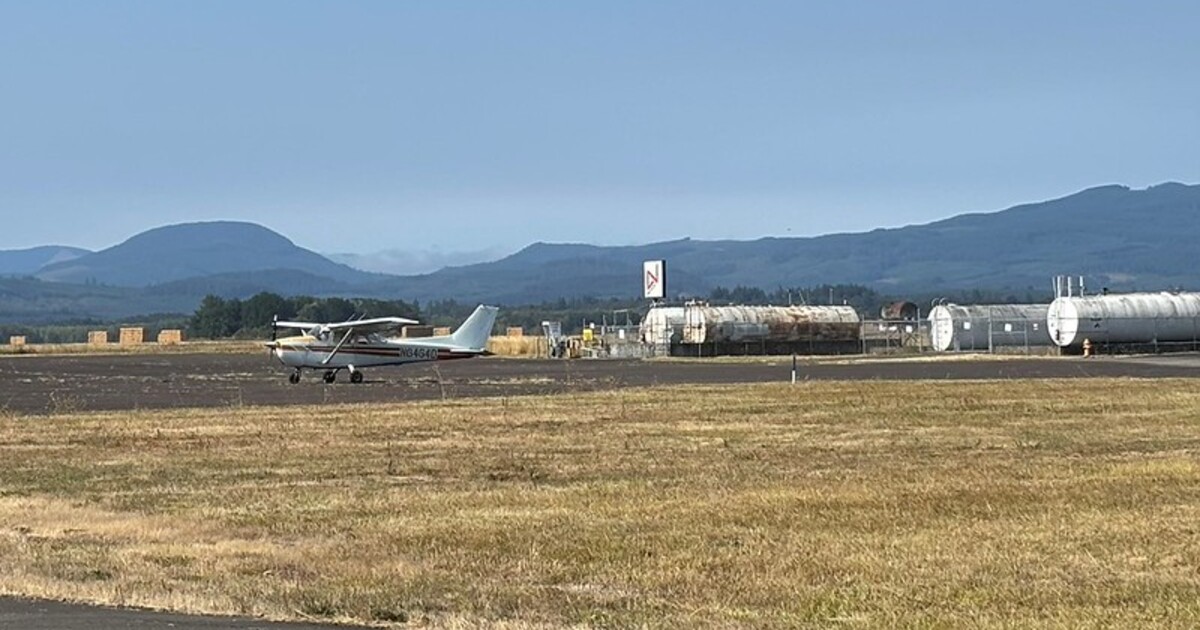
Lead contamination at airports is well-documented, but less is understood about how surrounding areas are impacted by lead. For the study, the researchers collected tree moss from neighborhoods near the Hillsboro and Troutdale, Oregon, airports – two of the top three lead-emitters in Oregon – and measured lead levels. Moss acts as an effective air monitoring system absorbing contaminants directly from the surrounding air, Shiel explained
“Using moss as a natural sensor gives us a clear, ground-level picture of where airborne lead settles in nearby communities,” Atkinson said
The researchers then used a technique called isotopic fingerprinting to determine theing leaded gasoline used by planes and leaded gas used by automobiles in the past, have distinct isotopic fingerprints
The researchers found levels of lead as much as 7 times higher near the airports compared to lead found in moss in other areas of Portland, and the dominant local leadon fuel were found nearest the runways but lead from aay, Shiel said
Nationally, more than 19,000 airport facilities service piston-engine aircraft that emit lead into the atmosphere. While this study focused on Hillsboro and Troutdale airports in Oregon, communities near other regional airports with piston-engine aircraft traffic may also face elevated environmental lead levels, said Shiel, who is also a member of the Pacific Northwest Center for Translational Environmental Health Research at OSU.
“Because smaller aircraft tend to use these smaller, regional airports, they tend to outpace the large international airports when it comes to lead emissions,” Shiel said
While leaded gas was phased out for automobiles in the 1990s, it remains the standard fuel for small piston-engine airplanes and helicopters. The Federal Art to transition away from leaded a-engine aircraft by the end of 2030
“These emissions don’t simply break down over time, they stay in the soil until it’s remediated or removed,” Shiel said. “People can be exposed to lead from a lead that accumulates in local dust and soil.”
Future research will focus on soil testing because the primary route of lead exposure for children is through the ingestion of contaminated soil and dust
Shiel has developed a website with an interactive map that allows users to check the lead levels at airports near their neighborhood. The website, https://ehsc.oregonstate.edu/our-research/research-highlights/leaded-aad contamination and how to reduce risk of exposure. For example:
- Take shoes off at the door to avoid tracking in lead-contaminated dust.
- Wash homegrown fruits and vegetables thoroughly.
- Wash children’s hands frequently, especially after playing outside and before eating.
The federal Centers for Disease Control and Prevention recommends all children who are at risk for lead exposure be tested for lead poisoning
“I would encourage parents to discuss lead testing with their child’s health provider,” Shiel said. “Seeking a blood lead level test or soil testing would be a reasonable course of action for concerned families.”
Additional co-authors are Lauren Stalford and Christina Murphy of Oregon State. Stalford first worked on the project as an undergraduate researcher at OSU
College of Earth, Ocean and Atmospheric Sciences
About the OSU College of Earth, Ocean, and Atmospheric Sciences (CEOAS):The college is renowned for research excellence and academic programs that span the earth, ocean and climate sciences, as well as the human dimensions of environmental change. CEOAS inspires scientific solutions for Oregon and the world
Source
Alyssa Shiel, [email protected]; Dean Atkinson, [email protected]
Image
Image