


Getting your Trinity Audio player ready…
Facing a “perfect storm” of financial pressures thanks largely to federal cuts, Cook County’s sprawling safety net health system is counting on the county board to fill a budget gap of $40 million this year
Without the subsidy, the leaders of Cook County Health — which runs Provident and Stroger hospitals and more than a dozen clinics across the county — said layoffs are on the table, along with community health center closures, specialty service cancellations and cuts to social safety net programs related to housing, food and behavioral health. Up to 154 people could lose their jobs
The money the health system requires was part of the initial $550 million preliminary gap announced earlier this summer, the largest in more than a decade. That shortfall included a $214 million CCH deficit, which has since been cut down to $40 million after various belt-tightening measures
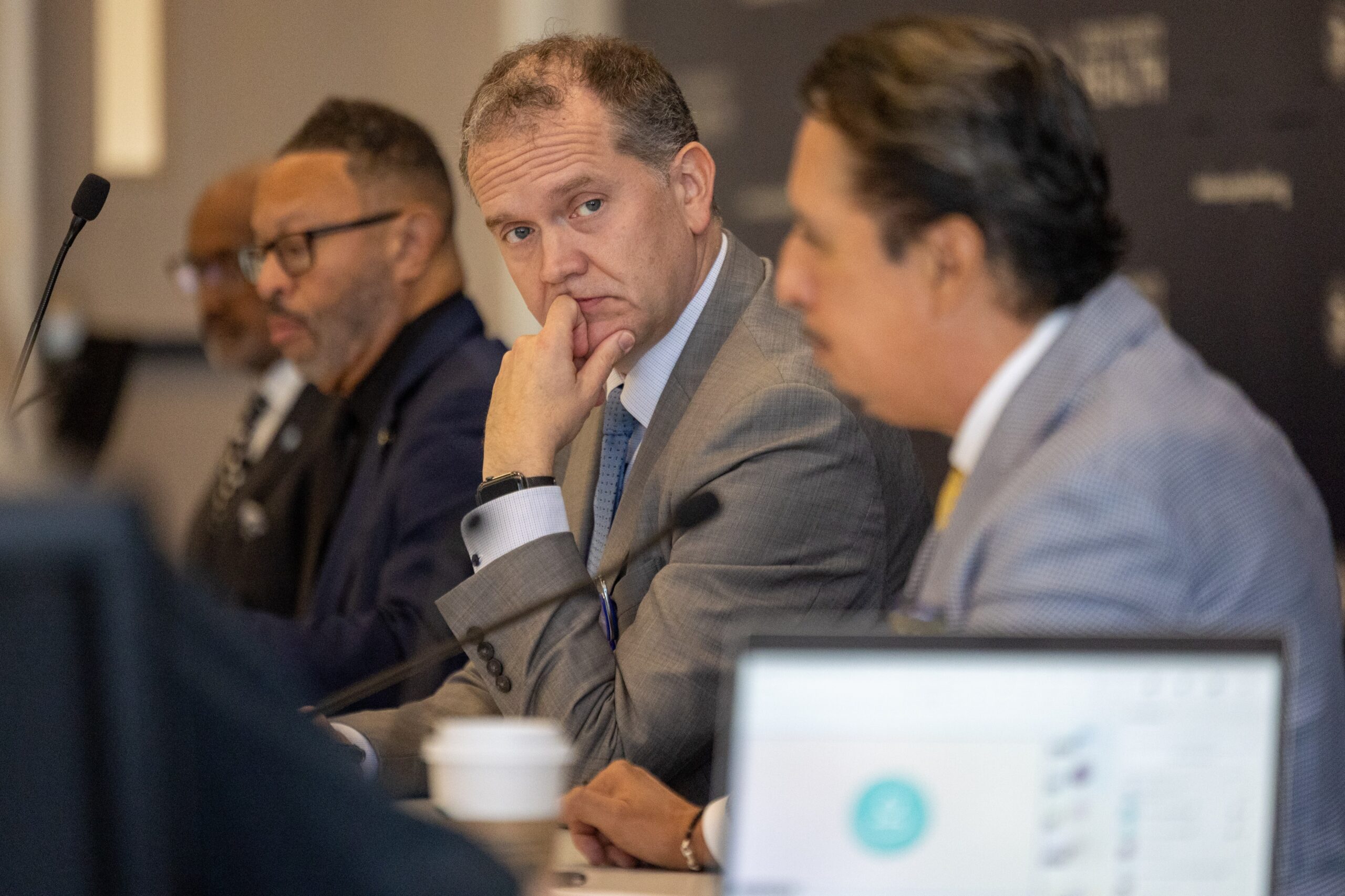
“This is one of the most challenging budgets Cook County Health has faced in many years, and I want to make it clear it’s not because we have failed to prepare,” CCH Board Chair Raul Garza said at a meeting earlier this month when the budget was introduced. “The reality is that we’re facing unprecedented federal funding reductions that will have significant consequences for safety net healthcare providers nationwide … it won’t compare to anything since the creation of Medicaid some 60 years ago.”
The health system’s proposed $4.7 billion budget, which must be approved by county commissioners as part of Cook County’s overall 2027 budget process this fall, is already $439 million less than this year. The public health system also operates the hospital at the Cook County Jail and oversees the county’s public health efforts
A series of changes to Medicaid eligibility and Affordable Care Act subsidies are hitting hospitals across the country. With its high percentage of Medicaid patients and as an operator of a Medicaid managed care organization called CountyCare, CCH is particularly vulnerable to the cuts
This past January, federal pandemic-era tax credits for people shopping for insurance through the ACA marketplace fell away. In October, certain immigrant populations like refugees, asylum-seekers and victims of domestic violence and trafficking will no longer be eligible for Medicaid. And at the start of next year, new work requirements and twice-annual eligibility checks will kick in for Medicaid patients
Those three changes could knock an estimated 400,000 off of some form of insurance across Illinois, according to the state’s Department of Healthcare and Family Services. Roughly half are in Cook County
Even patients that are eligible in spite of the changes risk loss of coverage because they are not aware the changes are coming or will be delayed by red tape: An April survey of nearly 2,000 Medicaid enrollees across the country from the Health Management Academy found 55% were unaware of the new work requirements — that enrollees would need to demonstrate they completed at least 80 hours of work, job training, education or community service per month to qualify. It found that 85% did not know eligibility determinations would take place every six months instead of every year.
CountyCare loses about 10% of its enrollees during the typical redetermination cycle — of those, about 70% lose coverage because of administrative issues, said Dr. Erik Mikaitis, CCH’s CEO
“It’s not that they’re not eligible; it’s that the state didn’t have an updated address or they didn’t get their paperwork back in time. So imagine what that does when you add a new procedure and work requirements, and you double the cadence of the existing process already. Then you are in a situation where most people don’t know that that’s happening, right? It’s going to be very, very bad,” Mikaitis said
CCH has helped set up a website, getmedicaidfacts.com, to distribute FAQs and connect people with the Illinois Department of Healthcare and Family Services
CCH’s historic mission has been to accept all patients regardless of their ability to pay. It has historically been the largest provider of charity care in Cook County. With so many people expected to lose coverage, the system is counting on lower total reimbursements from insurers and the federal government and more patients that can’t afford to pay out of pocket coming to the county for help
Adding to the financial burden: Without coverage, patients are also less likely to seek preventive care, meaning when they do show up, it would more likely be in the emergency room when they are sicker and more expensive to care for
“You screen for colon cancer; it’s $1,500 to $2,000 to do a colonoscopy. But treating stage-four colon cancer is like $130,000 per person. I mean, it’s mind-boggling the difference of the cost,” Mikaitis said. “That cost, unfortunately, because of these changes, gets pushed down to local governments and the safety net to figure out how to handle.”
County officials also fear those same pressures will contribute to the closures of other safety net hospitals already on the financial brink. Two such hospitals — Weiss and West Suburban — recently shuttered
CCH is projecting it will lose $138 million in patient revenue and shoulder more than $100 million in new charity care costs next year. They expect those costs to continue climbing during the rest of President Donald Trump’s term. CCH leaders already instituted a hiring freeze, cut agency staffing and are scaling back ICU and mental health stabilization units, which leaders said are being underutilized
The projected downturn is a blow to a system that has seen its finances steadily improve over the last decade. That success is due in large part to CountyCare, which turned CCH from not just a provider of care but to an insurer as well. One worry, Mikaitis acknowledged, is that CountyCare will have more liabilities than revenues — risking payments to other providers
“We’ve unfortunately seen a little bit of that this year, and the CountyCare team has been doing a lot to right the ship, and they’re right now on a trajectory to get on the right side of their budget for this year. But that’s exactly I think the challenges that we’re anticipating,” he said
The passage of the Affordable Care Act and expanded subsidies cut the percent share of “uncompensated” patients down to 13.1% in 2023. Next year, however, that share is supposed to climb to 30%
“We’re going backwards and we could be where we were 10 years ago,” said former County Commissioner Larry Suffredin, who served on the board from 2002 to 2022 and watched the health system grow from a worrisome financial burden on county taxpayers to becoming largely self-sufficient. The federal changes “will take the hospital from being a cash cow to the county and not make it a liability, but make it a financial concern for the county.”
So far, Mikaitis said CCH leaders “remain cautiously optimistic and exceedingly grateful” that both President Toni Preckwinkle and county board members have signaled they are willing to pay for the extra allocation. To drive his point home, Mikaitis said he has given commissioners a “hypothetical list” of clinics and service lines that would be cut without it, but did not share it
The ultimate solution is in Congress, said CCH board finance Chair Bob Reiter, president of the Chicago Federation of Labor, and Commissioner Bill Lowry, who sits on both the health system board and the county board. CCH board members and Preckwinkle are scheduled to visit lawmakers in Washington, D.C., in mid-September, Lowry told the Tribune
Reiter said he expects bipartisan pushback to the Medicaid rollbacks to crop up around the country next year, potentially leading to the restoration of coverage
“A lot of this is going to proportionally hit people in states that are dominated by Trump’s base and it’s going to have a big impact on everybody,” Reiter said. “Congressmen from Republican states are going to start getting screamed at by everybody in their community, so I don’t know how that shows up in terms of being able to turn around and fix this, but it’s not a crisis we’re going to deal with in a vacuum.”
