


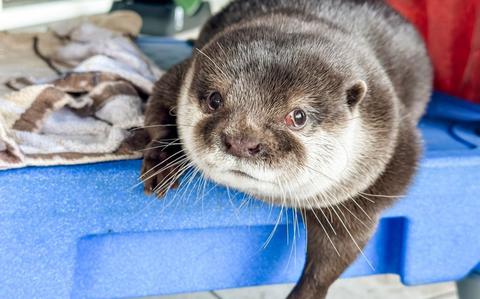
By LYDIA GORDON STARS AND STRIPES
Dogs and horses have long found a place in the military ranks, but service members at exercise Northern Strike in Michigan recently invited a new four-legged friend to teach them about rescue missions in difficult waters
Splash, an Asian river otter trained in detecting the deceased, was part of an extended presentation on creative thinking that was given to mortuary affairs personnel
The 2-year-old fuzzy investigator and his handler, Michael Hadsell, are no strangers to the task of finding human remains. The pair comes from Peace River Search and Rescue, a Florida-based nonprofit where Hadsell serves as president.
They visited Camp Grayling, Mich., from Aug. 5-7 for the large-scale joint military readiness and humanitarian exercise.
“This is actually the first time an otter has participated in the exercise,” 1st Lt. Paige Bodine, a spokesperson for the Michigan National Guard, said Tuesday. “We have previously incorporated detection canines and even vultures into our scenarios.”
Chief Warrant Officer 3 Andrew Carter, front, holds Splash, an Asian river otter, while posing with Michigan State Police dive team members at Camp Grayling, Mich. Splash took part in the recent Northern Strike exercise, showing off his skills in finding human remains. (Andrew Carter/U.S. Marine Corps)
A forensic diver and longtime animal trainer, Hadsell has spent decades working with dogs, horses and, more recently, otters to help locate human remains in places that can be difficult or dangerous for people to navigate, he said Tuesday
Splash is the fifth generation of Hadsell’s otter training program and, so far, its most successful. He is trained in a technique Hadsell calls “refinding.” Splash locates remains, returns to a trusted diver and then guides the diver back to the location.
The otter did not get the opportunity to demonstrate his skills in the Michigan waters
Hadsell began experimenting with training otters in 2020, believing that an animal naturally adapted to hunting in difficult aquatic environments could offer something traditional search teams could not, he said.
“Otters are a lot smarter than dogs,” Hadsell said. “They have a different set of priorities. … If they trust you, they will work for you.”
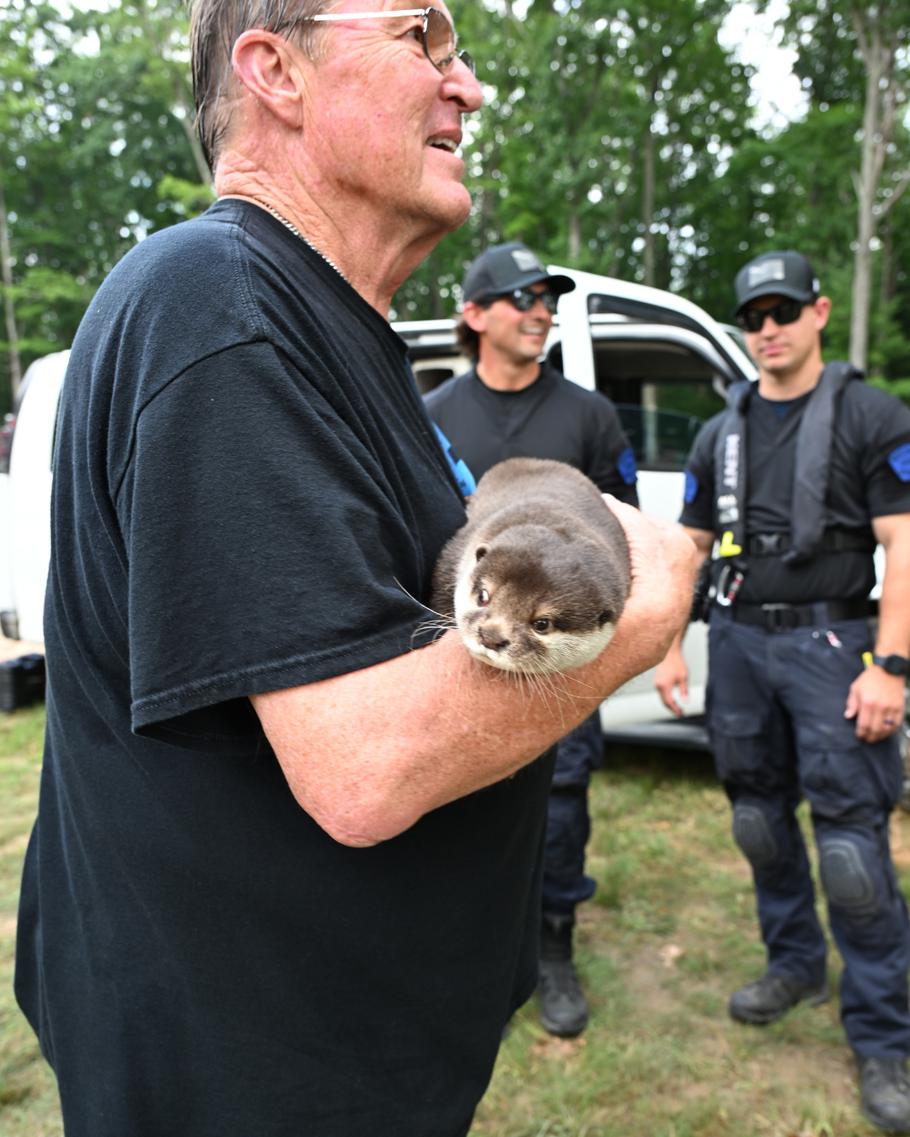
Handler Michael Hadsell holds Splash, an Asian river otter trained to find human remains, near a group of personnel in tactical gear at Camp Grayling, Mich., during exercise Northern Strike, which ran from Aug. 5-7. (Paige Bodine/Michigan National Guard)
Splash, an Asian otter trained to detect human remains underwater, searches a hollow brick for a hidden scent as part of a training demonstration with handler Michael Hadsell during Northern Strike. The exercise was held Aug. 5-7 at Camp Grayling, Mich. (American Animal Hospital Association)
In less than a year, Splash has been deployed on 33 searches for human remains, resulting in 11 successful recoveries
“The reason we do the otter program is to try to increase recovery rates,” Hadsell said
“So when we get to do the military stuff, we want to offer … that this may be a way to solve a problem that they’re working on,” he added
That possibility is what caught the attention of Chief Warrant Officer 3 Andrew Carter, the designated Marine innovations officer for mortuary affairs at Northern Strike.
“The idea of using other human remains detection animals is something we’ve pursued,” Carter said Tuesday.
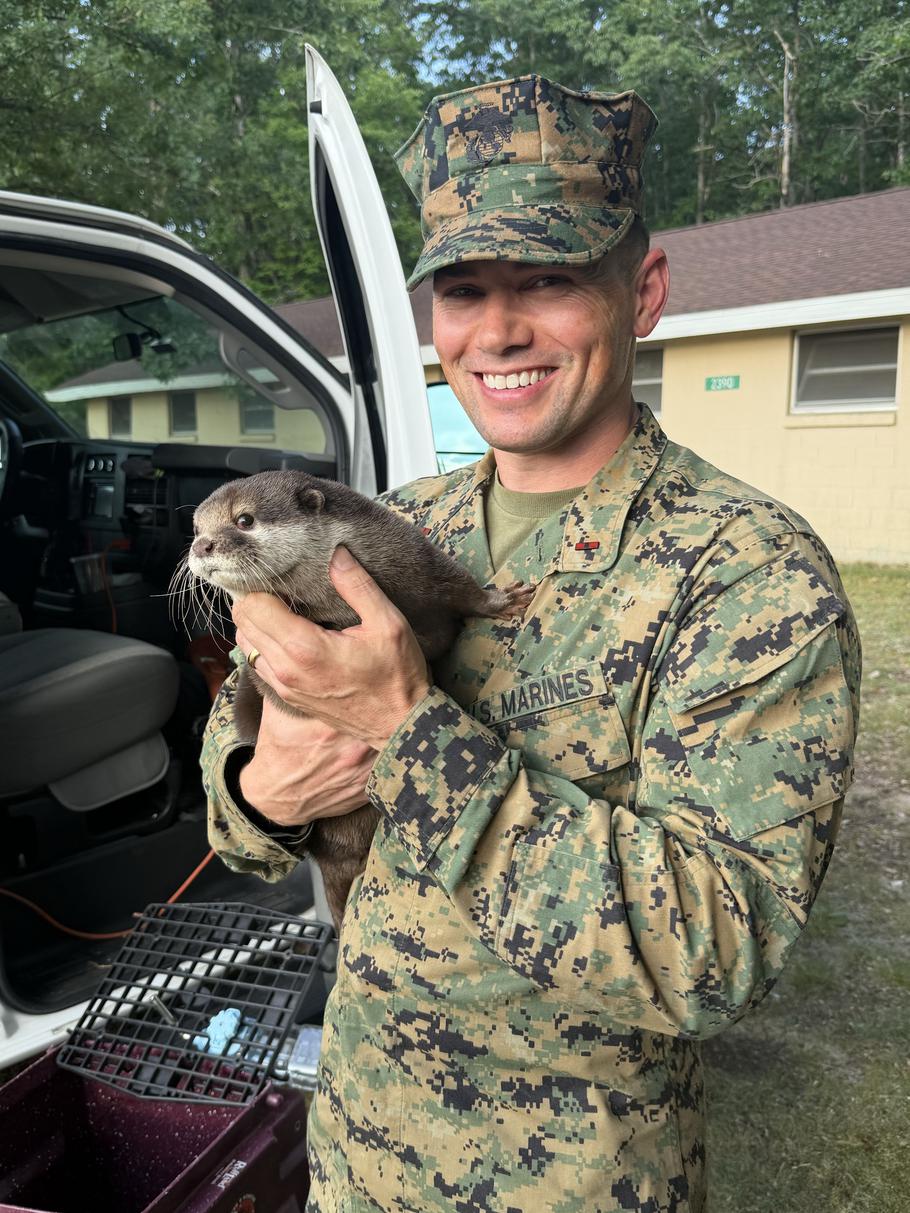
Chief Warrant Officer 3 Andrew Carter holds Splash, an Asian river otter trained to detect human remains. Carter, the Marine Corps mortuary affairs innovation officer for exercise Northern Strike, coordinated Splash’s integration into the training held Aug. 5-7 at Camp Grayling, Mich. (Andrew Carter/U.S. Marine Corps)
For the past few years, Carter has used Northern Strike to research new things “that can act as a force multiplier for our mission to bring the fallen home as efficiently as possible,” he said.
The exercise provided an opportunity to test some of those ideas, including the use of human remains detection dogs and turkey vultures and exploration into use of horses for the task. That pursuit eventually led Carter to Hadsell’s work with Splash.
Hadsell said they already plan to return to the exercise next year, when they hope Splash and perhaps a few of Hadsell’s detection horses will get the chance to showcase their specialized skills
But for Carter, Splash’s presence alone encouraged his Marines to think outside the box when approaching problems with human remains recovery.
“Not to mention the fact he’s the cutest thing you’ve ever seen,” Carter said
Military
Featured on Instagram
