


Listen to this article in summarized format
Loading…
×
×
Subscribe to
<img src="https://healthylife7.com/wp-content/uploads/2026/08/msid-76685415.cms_-7.png” alt=”ETPrime”>
Unlock AI Briefing and Premium Content
New Year Offer 24 Hours Left
Already a member? Sign In
What’s Included
- Exclusive Stories
- Daily ePaper Access
- Smart Market Tools
- Curated Investment Ideas
- Ad-lite Experience

Subscription


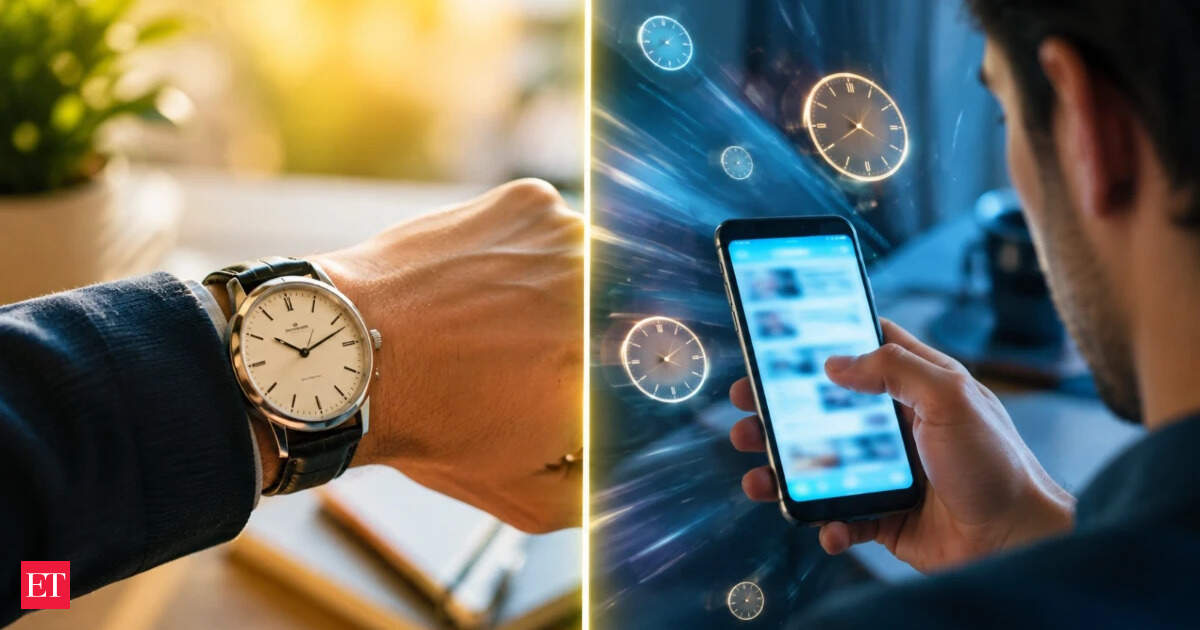
For some people, knowing the time means glancing at their wrist. For others, it means reaching for a smartphone, waking the screen and checking the digital display. The difference may seem insignificant, but psychology suggests that time is not experienced simply by reading a number from a clock. Our perception of time involves attention, memory, sensory information and the context in which events occur. A major review by psychologists Richard A. Block and Ronald P. Gruber describes psychological timing as involving processes such as duration judgments, temporal order, attention and memory. This does not mean that people who use smartphones instead of watches have a fundamentally different internal clock. Rather, the device they habitually use may influence how, when and where they encounter temporal cues.A watch provides an almost purely temporal signal, while a phone delivers the time alongside messages, notifications and countless other attention-grabbing possibilities.
Psychology Says Time Is More Than What the Clock Says
There is an important distinction between objective time and subjective time. A clock can tell you that 20 minutes have passed. Your brain may experience those 20 minutes as surprisingly short or painfully long.Researchers William J. Matthews and Warren H. Meck explain that subjective duration is affected by perception, allocation of attentional resources and past experience.Think about waiting for an important phone call. Five minutes can feel enormous when you are watching the clock. The same five minutes can disappear when you are absorbed in a conversation. The physical duration has not changed. The psychological processing of it has.You Might Also Like:

Psychology says people who use your full name when they’re angry may be signaling something deeper than a boundary
Why Checking a Phone Is Different From Looking at a Watch
A watch has one obvious job: displaying time. A smartphone has dozens. When someone looks at their watch, they can usually acquire the relevant information almost immediately. When they pick up their phone, however, they enter an environment filled with potentially competing information.A notification may appear. A message may be waiting. An email may attract attention. A social-media icon may be visible. This makes the attentional context surrounding the time cue different.Research on temporal cognition consistently shows that attention is involved in how people process and judge time. Block and Gruber’s review specifically discusses attentional models of prospective time judgments.
Psychology Says Attention Can Change How Time Feels
One influential idea is the attentional-gate model of time perception. In simplified terms, when people are paying attention to the passage of time, more temporal information is available to the cognitive system. When attention is diverted elsewhere, temporal processing can receive fewer resources.You Might Also Like:

Psychology says people who keep emergency cash in multiple places may think about future uncertainty differently
That can help explain a familiar experience. You check your phone because you want to know how long you have been waiting. Then you see a message and become absorbed in it. Suddenly, you are no longer monitoring time in the same way.Research reviews describe attention as an important factor in prospective timing and distinguish it from the processes involved when people estimate time retrospectively from memory.
Your Phone Can Become an External Time Cue
Psychology also recognizes the importance of external temporal cues. People use clocks, alarms, schedules, calendars and other environmental signals to coordinate behavior.A smartphone can become one of the most important of these tools. Someone might check it before leaving home, before a meeting, after lunch or while waiting for transportation.Eventually, the behavior can become highly familiar. The phone becomes associated with the question: “What time is it?”Interestingly, a 2026 multidisciplinary review of temporal cognition specifically discusses technologies that externalize time, including clocks and calendars, and considers how these tools can influence behavior and the way people organize temporal information.
Psychology Says Phone Users May Experience Time in More Fragmented Moments
A person wearing a watch has continuous access to a time display. A person who relies on a phone often checks the time in episodes.They might look at 9:15, then 10:02, then 11:37.Time awareness becomes connected to particular moments of checking. For example, someone working on a project may think:“I started when I checked my phone and it was 9:30.”Later:“It’s already 11.”These moments become temporal landmarks in the person’s memory.This matters because psychological time is closely linked with memory as well as immediate perception. Matthews and Meck’s review notes that subjective duration is influenced by past experience and memory processes.
The Internal Clock Theory Offers Another Explanation
Psychologists have long investigated the idea that humans possess an internal clock or timing mechanism.The internal-clock approach is not a claim that there is literally a tiny clock inside the brain. Rather, it is a family of psychological and neurobiological models explaining how organisms represent temporal intervals.Research by Melissa J. Allman, Sundeep Teki, Timothy D. Griffiths and Warren H. Meck describes models involving clock speed, temporal memory, rhythm, multisensory integration and attentional time-sharing.From this perspective, checking a phone instead of wearing a watch is unlikely to simply “change” the internal clock. Instead, the phone provides an external reference pointagainst which internal timing can be compared.
Psychology Says Habits Can Determine When We Notice Time
There is also a behavioral component. If someone has never worn a watch, reaching for a phone may become their automatic response whenever they become uncertain about the time.That is a form of habitual cue-response behavior. The cue is uncertainty about time. The familiar response is checking the phone.After years of repetition, the person may not consciously decide to perform the behavior.This is particularly interesting because smartphones combine timekeeping with many other digital activities. The same device that answers “What time is it?” can immediately invite the user to do something else.That creates a different attentional environment from a traditional watch.
A Smartphone Can Blur the Boundary Between Timekeeping and Attention
Imagine someone waiting at an airport. They check their phone to see whether it is time to board. The screen says 6:20 p.m. But they also see a message. They answer it. Then they check the weather. Then they open another application.Five minutes later, they return to the boarding information. The original goal was simply to obtain a temporal cue. Instead, the time check became an attentional transition.This does not mean smartphones inherently distort time perception. It means the device can place time information inside a much broader cognitive environment.Research on temporal attention shows that attention can be selectively allocated to particular moments and that temporal expectations influence how incoming information is processed.
Psychology Says the Difference Is About Time Cues, Not Personality
It would be an overstatement to conclude that people who use phones instead of watches are less punctual, more distracted or psychologically different.There is no established personality type based on whether someone wears a watch. People may simply find smartphones more convenient.Others may dislike wearing anything on their wrist. Some may prefer digital displays. The psychological difference is more subtle. A watch provides continuous, dedicated access to a temporal signal.A phone provides intermittent access to time embedded within a multifunctional device. Those are different sensory and attentional experiences.
The Way You Check Time May Shape When Time Enters Awareness
Someone who checks their phone instead of wearing a watch may not experience time fundamentally differently. But they may encounter time cues differently.Their awareness of time may be tied to specific checking moments, habitual behaviors and the attentional environment surrounding the smartphone.The emerging research on temporal cognition reinforces the idea that our experience of time is constructed through interactions between perception, attention, memory and external temporal structures.So the difference between looking at your wrist and reaching into your pocket is more psychologically interesting than it first appears. The clock has not changed. The cue has changed, and the way the brain encounters that cue can influence how time enters everyday awareness.
FAQs:
Does checking the time on a phone mean someone has a different sense of time?
Not necessarily. There is no established psychological profile associated with checking a phone instead of wearing a watch. The more defensible conclusion is that the person may encounter temporal information through a different attentional and behavioral routine.
Is checking a phone different from looking at a watch?
Potentially. A watch is primarily a dedicated timekeeping device, whereas a smartphone combines time information with many other potential stimuli. That difference can change the attentional context in which the time is noticed.Add 
as a Reliable and Trusted News Source

Add Now!
(You can now subscribe to our Economic Times WhatsApp channel)
( Originally published on Aug 18, 2026 )
Read More News on
checking time on phonepsychological timingsmartphone vs watchtime perceptionhow attention affects timeinternal clock theory
(Catch all the US News, UK News, Canada News, International Breaking News Events, and Latest News Updates on The Economic Times.)
Download The Economic Times News App to get Daily International News Updates
…moreless
(You can now subscribe to our Economic Times WhatsApp channel)
Read More News on
checking time on phonepsychological timingsmartphone vs watchtime perceptionhow attention affects timeinternal clock theory
(Catch all the US News, UK News, Canada News, International Breaking News Events, and Latest News Updates on The Economic Times.)
Download The Economic Times News App to get Daily International News Updates
…moreless
