


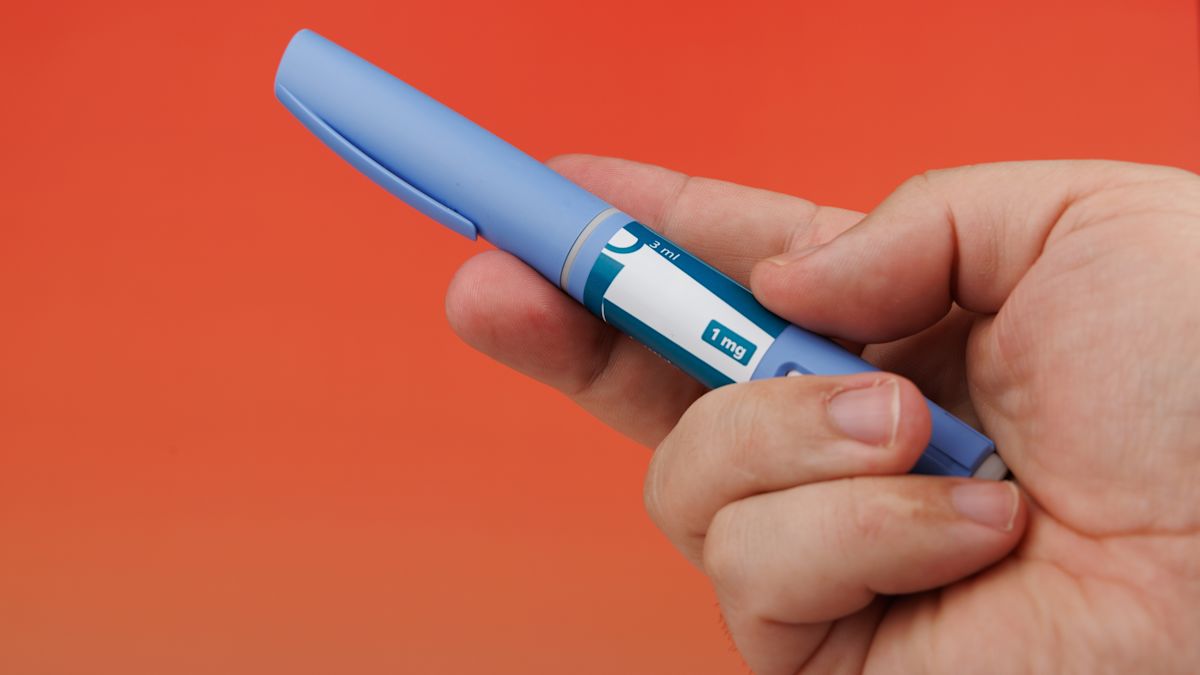
How can a medication that is life-changing for one person not have much of an impact on someone else? Two people can begin the identical GLP-1 prescription, at the exact same dose, and finish the year with completely different results. Research from the 23andMe Research Institute revealed just how wide that gap runs: some people drop less than 5 percent of their body weight, or even gain weight on the medication, while others lose well over 20 percent of their body weight.
That significant difference is the central puzzle of the Ozempic era. So why the gap? Dr. Anthony Puopolo has been tracking that research closely, and he shared his insights on this topic that puzzles so many of us
About Our Expert:Dr. Anthony Puopolo is a board-certified physician with psychiatry training and the chief medical officer at LifeMD. He has 25 years of experience in the medical field
Why the way you overeat may predict whether Ozempic works
Some people overeat because food looks and smells too good to resist. Others turn to it to ease stress, anxiety, or bad moods. That distinction may shape how well a GLP-1 drug works: <a href="https://www.frontiersin.org/journals/clinical-diabetes-and-healthcare/articles/10.3389/fcdhc.2025.1638681/full” rel=”nofollow noopener” target=”_blank”>research out of Japan found that the first group tends to lose more weight, while emotional eaters see weaker results.
Advertisement
Dr. Puopolo didn’t name that as a reason to withhold the drug. He called emotional eating “not a contraindication to GLP-1RA use, but rather a signal” that more help may be needed. He added that options range from behavioral approaches like cognitive behavioral therapy and stress management to other medications such as naltrexone or bupropion.
Identifying these patterns doesn’t require a lab. Dr. Puopolo shared that questionnaires like the Dutch Eating Behavior Questionnaire or the Emotional Eating Questionnaire “can be administered in minutes” and can sort patients into external, emotional, or restrained eaters
Can a genetic test tell you if Ozempic will work?

Stanford Medicine researchers have identified genetic variants, carried by roughly one in ten people, that appear to blunt the GLP-1 drugs’ effect even though those individuals produce more of the hormone themselves. The obvious dream is a cheek-swab test that tells you upfront whether a shot is worth it.
Puopolo was clear when explaining the timeline. “A clinically useful pre-treatment genetic test to predict GLP-1 drug response is not yet close to clinical readiness, despite genuinely important recent discoveries,” he said
Advertisement
He acknowledged that the variants are genuine, but their individual influence is limited: “The genetic effects identified so far are real but they’re small.” What works better than any gene panel today is almost disappointingly simple. The strongest signal available, he pointed out, is how much weight a patient loses early on: a drop of at least 5 pounds in the first three months “outperforms any known genetic marker.”
Who loses the most weight on Ozempic, and who loses the least
Beyond DNA, a handful of ordinary clinical traits do a surprising amount of predictive work. Puopolo was direct about the biggest one. “Gender is the strongest demographic predictor,” he said: women, on average, lose more on these drugs than men
He added two further patterns from the evidence base. People with Type 2 diabetes tend to shed somewhat less than those without it, and emotional eaters generally land at the lower end of the weight-loss curve. Puopolo explained that rapid early progress tends to forecast a larger total result over time
Your pancreas makes its own GLP-1. Does that change anything?
A 2025 Duke University discovery that pancreatic alpha cells naturally churn out meaningful amounts of GLP-1 raised an intriguing possibility: maybe people who feel dramatic effects on a tiny dose simply make more of the hormone on their own. Dr. Puopolo found the science genuinely important for understanding the pancreas, and possibly for future therapies that coax the body into making more of its own GLP-1
Advertisement
As a predictive tool, though, he was unconvinced. “Measuring baseline endogenous GLP-1 levels is not currently useful for predicting who will respond to semaglutide or tirzepatide,” he clarified, attributing the dose-response swings instead to receptor genetics, brain sensitivity, and eating behavior
What your gut microbiome has to do with Ozempic
The relationship between these drugs and gut bacteria runs in both directions: the microbiome shapes how the medication performs, and the medication reshapes the microbiome. Early evidence even links baseline bacterial makeup to blood-sugar response, but Dr. Puopolo drew a firm boundary around the popular idea that patients should be “fixing” their gut before they begin. That link hasn’t been confirmed for weight loss specifically, he observed, and there is “no evidence supporting pre-treatment microbiome optimization” before starting these drugs.
Losing fat versus losing muscle on Ozempic

A University of Virginia study delivered an uncomfortable footnote to the weight-loss story: the drugs trim pounds without improving cardiorespiratory fitness, and some of what disappears is muscle. Dr. Puopolo confirmed the concern is real, noting that roughly a third of the weight people lose is not fat but fat-free mass, with older adults, men, and rapid losers most at risk
“The two main ways to counteract muscle mass loss are high intake protein and resistance training,” he said. He also offered a hopeful wrinkle from a tirzepatide imaging substudy, which suggested that the muscle left behind may actually function better thanks to reduced fat infiltration, meaning raw lean-mass figures can overstate the real-world damage
The new Wegovy pill versus the shot: does it change your results?

With an oral form of Wegovy arriving in 2026, patients now face a choice between a daily tablet taken on a strict empty stomach and an injection that skips the gut entirely. Dr. Puopolo framed the trade-off in terms of discipline rather than chemistry. “Oral and injectable semaglutide are pharmacologically equivalent when the oral form is taken correctly,” he said, but the pill carries a ceiling tied to how faithfully a person follows the protocol. For patients whose schedules or other medications make that hard, he suggested, the shot delivers more predictable results.
More than appetite: how GLP-1 drugs change the brain
Some of the most striking reports from GLP-1 users have nothing to do with food. People describe fading urges to drink, shop, or smoke. Dr. Puopolo characterized this as evidence that the drugs reach the brain’s reward circuitry, with the clearest data so far around alcohol and emerging signals for nicotine, opioids, and compulsive behaviors
Advertisement
The mechanism, he reflected, is subtle. “The drug does not eliminate pleasure.” Instead it dials down the pull toward a reward, what he described as “the ‘wanting’ rather than the ‘liking.'” That, he argued, recasts these medications from “appetite suppressants” into “broad neuromodulators of motivational salience,” and may explain mental-health benefits that weight loss alone cannot account for
Ozempic is not just a weight-loss drug

Increasingly these medications are being described as heart and metabolic drugs that happen to cause weight loss, and Dr. Puopolo believes a real group of patients is missing out because of outdated labels. “The reframing from ‘weight-loss drug’ to ‘cardiometabolic medication’ is not aspirational,” he stressed, pointing to trial data showing cardiovascular benefit that held up independent of starting weight
He attributed the under-prescribing to several forces: specialty silos that still treat these as diabetes drugs, despite a JAMA Cardiology review urging cardiologists to begin prescribing them directly; insurance rules tied to BMI; cost; and a public conversation still fixated on slimming down
What happens when you stop taking Ozempic
A lot has been said about people regaining weight after they stop taking GLP-1 medications. The re-gain problem is real and well documented. Dr. Puopolo was blunt that the drugs don’t hand most people a permanent metabolic reset, citing “weight regain in the range of 75 percent within one year is the norm” after discontinuation. He did flag exceptions, including patients with prediabetes who adopt durable lifestyle changes or those who started at a lower weight. His overarching counsel, though, treats the condition itself as the constant: “obesity is a chronic, relapsing disease analogous to hypertension,” typically demanding ongoing treatment to hold the gains.
Could a single test predict whether Ozempic will work for you?
So how far away is the panel that scans your genes, gut, hormones, and psychology and pronounces a verdict before you ever fill the prescription? Dr. Puopolo put it at “5 to 10 years from routine clinical use,” and he questioned the urgency. Unlike cancer, where the wrong drug can be fatal, the stakes here are low. As he put it, a less-than-ideal choice just means “the patient loses less weight but can switch agents.”
Advertisement
For now, the smartest move is also the most practical one. He summarized that “the most impactful step available right now is not a genetic test.” What matters more, he said, is matching the drug to a patient’s eating profile and other health conditions, then watching how they respond in the first three months, an approach already recommended by the American Diabetes Association. In other words, the best predictor of whether Ozempic will work for you may simply be what it does in your first ninety days.
Thanks for reading. I invite you to follow me on Yahoo for more reporting on health and wellness
More About Our Expert: This article draws on an interview with Dr. Anthony Puopolo, who has served as Chief Medical Officer of LifeMD since 2021 and brings more than 25 years of experience in the medical field. He earned a B.A. in Biology from Tufts University, an M.A. in Biology from Boston University, and his M.D. from the Boston University School of Medicine, then completed a combined Family Medicine and Psychiatry residency in the U.S. Army at Tripler Army Medical Center in Honolulu, Hawaii. He also completed an intensive integrative-wellness fellowship with Dr. Andrew Weil at the University of Arizona, is a member of the American Board of Family Medicine, and is board-eligible in Psychiatry. He has been closely involved in building the LifeMD Weight Management Program.
The reporting also cites peer-reviewed and institutional research, linked throughout: the 23andMe Research Institute analysis in Nature; the Stanford Medicine and ETH Zurich study in Genome Medicine; the Kyoto University eating-behavior study in Frontiers in Clinical Diabetes and Healthcare; the Duke University finding in Science Advances; the University of Virginia review in the Journal of Clinical Endocrinology & Metabolism; the SURPASS-3 MRI substudy and the SELECT adiposity analysis, both in Lancet titles; a JAMA Cardiology review; and Novo Nordisk’s announcement of FDA approval for the oral Wegovy pill.
Advertisement
Please note: Robin Raven is a journalist covering health and medicine. This article is for general informational and educational purposes only and does not constitute medical advice. It is not a substitute for professional diagnosis, treatment, or guidance from a qualified healthcare provider. GLP-1 medications are prescription drugs with potential risks and side effects, and individual results vary widely. Do not start, stop, or change any medication based on this article. Always consult your physician or another licensed healthcare professional about your specific circumstances before making medical decisions. The views expressed by Dr. Puopolo reflect his clinical perspective and the research available at the time of publication, and may not apply to your individual situation.
Robin Raven Creator
Robin Raven is a journalist who covers travel, entertainment, health, wellness and more. You can often find her writing songs, flying somewhere she’s never been, reading and listening to Taylor Swift.
Creators are not employed by Yahoo. Views expressed by creators do not reflect the opinions and position of Yahoo.Learn how to become a creator.
