


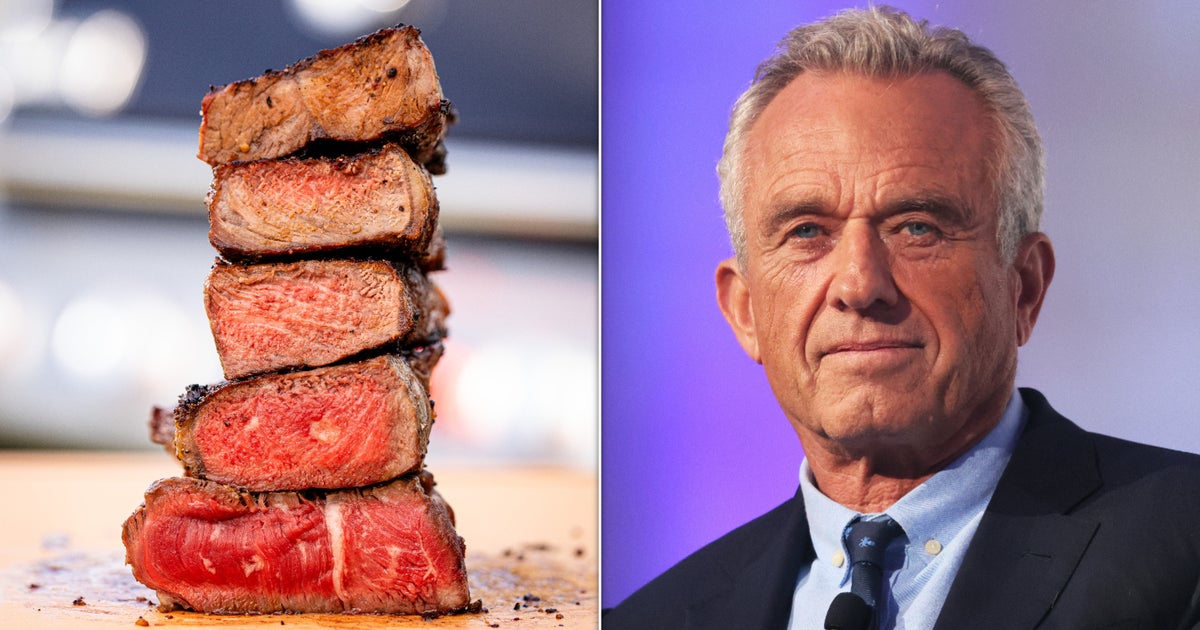
Health and Human Services Secretary Robert F. Kennedy Jr. often plugs his steak-and-fermented-foods-only diet, and now several Trump Cabinet members have adopted it. By the sounds of it, they’ve all got some interesting bowel movements to show for it
According to a New York Times Magazine article published this week, JD Vance, Howard Lutnick, Sean Duffy and the aforementioned RFK Jr. have all taken up the “Living Diet,” a steak and sauerkraut-heavy meal plan created by Dr. Sean O’Mara, who’s interviewed in the piece
As reporter Willy Staley writes, Trump’s carnivore-loving crew “eat nothing but flesh of grass-fed ruminants — cows, yes, but also bison, elk and venison — and as many different fermented foods as possible, because their bacteria help repopulate your gut, which [O’Mara] says improves your metabolism, leading to weight loss.” (President Donald Trump has already noticed Vance’s trimmed-down figure, Staley notes, while Kennedy has reduced his visceral fat load by 40%.)
O’Mara allows wild-caught seafood, too, but says that ruminants are best, “because they ferment what they eat in their many stomachs.”
Eating solely steak and sauerkraut isn’t just good for your waistline, as O’Mara claims. It also produces some pretty spectacular poops. Per Staley:
At one point in our conversation [O’Mara] pulled up the Bristol Stool Chart, which ranges from Type 1 (“separate, hard pellets”) to Type 7 (“watery, no solid pieces”). O’Mara is consistently delivering Type 4 (“smooth, soft, like a snake”), with pointed ends, indicative of healthy rectal function, he told me. “When you start eating healthy, you don’t need toilet paper,” he claimed. “Animals in the wild have no residual stool on their anus.” He described a proper bowel movement to me this way: odorless, wipe-free, over in three to seven seconds and “nearly orgasmic.”
“I could have a bowel movement behind a sheet at a dinner party in the corner of the room,” he said, “and nobody would know.”
Wow, that’s quite the party trick
Curious whether those claims pass the smell test, we turned to a gastroenterologist to see what they thought
According to Dr. Saurabh Sethi, a gastroenterologist and hepatologist in Fremont, California, a diet with so little fiber ― which is obtained from plant-based foods, including fruits, vegetables, whole grains, legumes, nuts and seeds ― and so much protein is a “classic recipe for constipation.”
“Fiber adds bulk and holds water in stool, which is what keeps things moving; without it, transit time slows and stools tend to become harder and less frequent,” Sethi told HuffPost
Michael M. Santiago via Getty Images / Mike Lang via Getty Images
Some people on very high-meat diets report the opposite of what O’Mara claims about his BMs: They have more frequent loose stools, which is more likely a sign of fat malabsorption or a bile-acid response to a large fat load than a sign the diet is “working.”
“Neither extreme is a marker of good colon health,” Sethi said. “Frankly, if your bowel movements are changing dramatically after a major diet shift, that’s your gut telling you something’s off-balance, not optimized.”
Sethi said he’d be concerned about these men’s diets for another reason as well: It’s a meat-heavy meal plan, which is a cardiovascular disease risk factor
That much meat opens the door to a litany of elements that could compromise the colon’s well-being
“From a colon-health standpoint, I’d be cautious about this pattern,” Sethi said. “The colon relies on fiber to feed beneficial bacteria that produce short-chain fatty acids like butyrate, which is the primary fuel for colon cells and is linked to a lower risk of colorectal cancer.”
Kennedy’s “carnivore diet” reportedly eliminates nearly all plant foods — including fruits, vegetables (aside from some fermented varieties), grains and legumes — leaving it devoid of plant fiber. (Interestingly, it’s an approach that doesn’t exactly align with Kennedy’s updatedU.S. dietary guidelines, which emphasize protein but still recommend eating a variety of foods from other food groups.)
A mostly all-ruminant-meat diet like we’re talking about contains little fiber, so you’d be removing the substrate your gut bacteria need most, Sethi said
ALEX WROBLEWSKI via Getty Images
There’s also the separate question of red meat itself: Sethi says the WHO’s International Agency for Research on Cancer classifies unprocessed red meat as probably carcinogenic (Group 2A) based on limited evidence plus strong mechanistic evidence, tied mainly to colorectal cancer risk
Red meat carries a lower cancer risk than processed meats like bacon and deli meat, which have the strongest evidence linking them to cancer, but the concerns still apply, the doctor said
As for the men’s trimmed-down figures, “any weight loss on this diet is more likely explained by calorie restriction and appetite suppression from very high protein intake, not by a special metabolic effect of ruminant meat,” Sethi said
While meat can be a greats been linked to a higher risk of conditions like colon cancer and heart disease. If you’re primarily looking to boost your protein intake, experts don’t even rank red meat among the best options. In a February HuffPost story on the best protein, beans, soy, walnuts and chicken
Sethi is a fan of the fermented-food piece of their diet: Fermented foods like the kimchi, kefir and sauerkraut Kennedy and the others are eating do show some evidence for modestly increasing microbiome diversity
“But that benefit is happening despite the all-meat framework, not because of it,” he said
