


Abstract
Background
Childhood growth is crucial for long-term overall health and well-being. Diet quality is an essential component of nutritional status reflecting dietary patterns and nutrient intake. While research in adults has shown that higher diet quality is associated with a lower risk of obesity, its association with childhood growth has remained unclear. This study aims to evaluate the association between diet quality among toddlers and their growth in later childhood
Methods
Mothers from Upstate KIDS, a prospective cohort study, reported numbers of servings/day for specific foods, such as dairy, fruit, vegetables, and meat, fed to their toddlers at 2.5- and 3-years along with behaviors such as breakfast intake. Accordingly, the Youth Healthy Eating Index (YHEI) was calculated to measure toddler diet quality (range 0-65) with higher scores indicating better toddler diet quality. Children’s height, weight, and waist circumference were reported up to three times in questionnaires from 7- to 9-years, and corresponding height-for-age (HAZ), weight-for-age (WAZ), body mass index-for-age (BMIZ) z-scores and obesity status were calculated. Mixed effects models were used to estimate associations with YHEI scaled per five-unit increase, adjusting for maternal age, race/ethnicity, education, insurance status, government assistance, fertility treatment, smoking, parity, pre-pregnancy BMI, child age, sex, plurality, breastfeeding duration, and complementary feeding.
Results
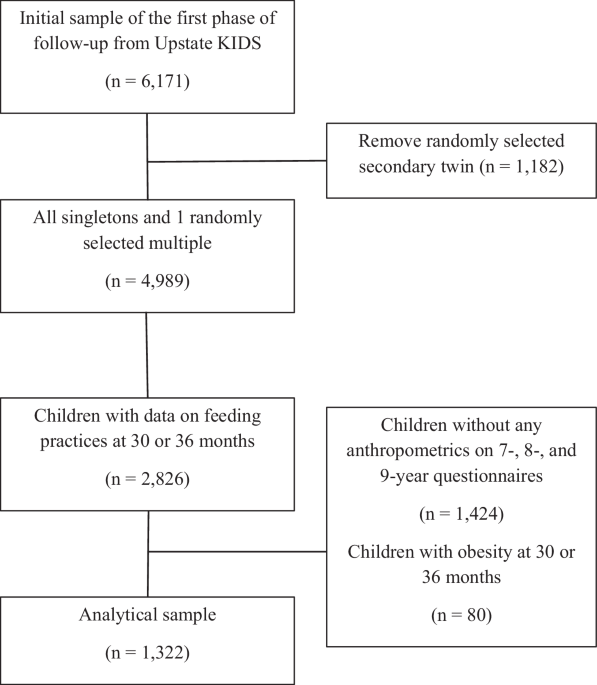
Among 1322 children (52.0% male), the mean YHEI score in toddlerhood was 44.4(pm)8.52 (mean (pm ,)standard de. Higher YHEI scores were significantly associated with lower odds of developing central obesity (adjusted OR = 0.74, 95% CI: 0.56, 0.98). YHEI scores were not associated with HAZ, WAZ, BMIZ, waist circumference, and obesity after adjusting for covariates
Conclusion
Higher toddler diet quality is associated with reduced odds of central obesity in later childhood. Interventions aimed at improving early diet quality are needed to promote healthy growth in childhood
Access through your institution
Buy or subscribe
This is a preview of subscription content, access
Access options
Access through your institution
- Purchase on SpringerLink
- Instant access to the full article PDF.
39,95 €
Prices may be subject to local taxes which are calculated during checkout
Data availability
The data used in this study will be made available on reasonable request following approval of a data use agreement from the corresponding author [EY]
Code availability
The code used in this study will be made available on reasonable request following approval of a data use agreement from the corresponding author [EY]
References
Thompson AL. What is normal, healthy growth? Global health, human biology, and parental perspectives. Am J Hum Biol. 2021;33:e23597
Casadei K, Kiel J. Anthropometric measurement: StatPearls Publishing. 2022
Ng M, Dai X, Cogen RM, Abdelmasseh M, Abdollahi A, Abdullahi A, et al. National-level and state-level prevalence of overweight and obesity among children, adolescents, and adults in the USA, 1990–2021, and forecasts up to 2050. Lancet. 2024;404:2278–98
Liu J, Zhao Y, Tian Y, Jiang N, Zhao G, Wang X. Trends in abdominal obesity and central adiposity measures by dual-energy x-ray absorptiometry among US children: 2011–8. Front Pediatr. 2022;10:903413
Simmonds M, Llewellyn A, Owen CG, Woolacott N. Predicting adult obesity from childhood obesity: a systematic review and meta-analysis. Obes Rev. 2016;17:95–107
Sahoo K, Sahoo B, Choudhury AK, Sofi NY, Kumar R, Bhadoria AS. Childhood obesity: causes and consequences. J Family Med Prim Care. 2015;4:187–92
Purnell JQ. Definitions, Classification, and Epidemiology of Obesity. In: Feingold KR, Ahmed SF, Anawalt B, Blackman MR, Boyce A, Chrousos G, et al., editors. Endotext. South Dartmouth (MA): MDText.com, Inc. 2000
Ragino YI, Stakhneva EM, Polonskaya YV, Kashtanova EV. The role of secretory activity molecules of visceral adipocytes in abdominal obesity in the development of cardiovascular disease: a review. Biomolecules. 2020;10:374
Wirt A, Collins CE. Diet quality – what is it and does it matter?Public Health Nutr. 2009;12:2473–92
da Costa MP, Severo M, Araújo J, Vilela S. Longitudinal tracking of diet quality from childhood to adolescence: the Interplay of individual and sociodemographic factors. Appetite. 2024;196:107279
Lioret S, Campbell KJ, McNaughton SA, Cameron AJ, Salmon J, Abbott G, et al. Lifestyle patterns begin in early childhood, persist and are socioeconomically patterned, confirming the importance of early life interventions. Nutrients. 2020;12:724
Woo JG, Reynolds K, Summer S, Khoury PR, Daniels SR, Kalkwarf HJ. Longitudinal diet quality trajectories suggest targets for diet improvement in early childhood. J Acad Nutr Diet. 2021;121:1273–83
Appannah G, Murray K, Trapp G, Dymock M, Oddy WH, Ambrosini GL. Dietary pattern trajectories across adolescence and early adulthood and their associations with childhood and parental factors. Am J Clin Nutr. 2021;113:36–46
Movassagh E, Baxter-Jones A, Kontulainen S, Whiting S, Vatanparast H. Tracking dietary patterns over 20 years from childhood through adolescence into young adulthood: the Saskatchewan pediatric bone mineral accrual study. Nutrients. 2017;9:990
Tarro S, Vahtera J, Pentti J, Niinikoski H, Raitakari O, Rönnemaa T, et al. Diet quality trajectories from infancy to young adulthood: the special turku Coronary Risk Factor Intervention Project (STRIP) study. J Nutr. 2025;155:1923–32
Dalwood P, Marshall S, Burrows TL, McIntosh A, Collins CE. Diet quality indices and their associations with health-related outcomes in children and adolescents: an updated systematic review. Nutr J. 2020;19:1–43
Gil Á, Martinez de Victoria E, Olza J. Indicators for the evaluation of diet quality. Nutr Hosp. 2015;31:128–44
Kennedy ET, Ohls J, Carlson S, Fleming K. The healthy eating index: design and applications. J Am Diet Assoc. 1995;95:1103–8
Feskanich D, Rockett HRH, Colditz GA. Modifying the Healthy Eating Index to assess diet quality in children and adolescents. J Am Diet Assoc. 2004;104:1375–83
Asghari G, Mirmiran P, Yuzbashian E, Azizi F. A systematic review of diet quality indices in relation to obesity. Br J Nutr. 2017;117:1055–65
Larruy-García A, Mahmood L, Miguel-Berges ML, Masip G, Seral-Cortés M, De Miguel-Etayo P, et al. Diet quality scores, obesity and metabolic syndrome in children and adolescents: a systematic review and meta-analysis. Curr Obes Rep. 2024;13:755–88
Kranz S, Findeis JL, Shrestha SS. Use of the Revised Children’s Diet Quality Index to assess preschooler’s diet quality, its sociodemographic predictors, and its association with body weight status. J Pediatr. 2008;84:26–34
Thomson JL, Landry AS, Tussing-Humphreys LM, Goodman MH. Diet quality of children in the United States by body mass index and sociodemographic characteristics. Obes Sci Pract. 2019;6:84–98
Zheng X, Wang H, Wu H. Association between diet quality scores and risk of overweight and obesity in children and adolescents. BMC Pediatr. 2023;23:169
Martíncrespo-Blanco MC, Varillas-Delgado D, Blanco-Abril S, Cid-Exposito MG, Robledo-Martín J. Effectiveness of an Intervention Programme on Adherence to the Mediterranean Diet in a Preschool Child: A Randomised Controlled Trial. Nutrients. 2022;14:1536
Notario-Barandiaran L, Valera-Gran D, Gonzalez-Palacios S, Garcia-de-la-Hera M, Fernández-Barrés S, Pereda-Pereda E, et al. High adherence to a mediterranean diet at age 4 reduces overweight, obesity and abdominal obesity incidence in children at the age of 8. Int J Obes. 2020;44:1906–17
Sørensen LMN, Aamodt G, Brantsæter AL, Meltzer HM, Papadopoulou E. Diet quality of Norwegian children at 3 and 7 years: changes, predictors and longitudinal association with weight. Int J Obes. 2022;46:10–20
Tognon G, Hebestreit A, Lanfer A, Moreno LA, Pala V, Siani A, et al. Mediterranean diet, overweight and body composition in children from eight European countries: cross-sectional and prospective results from the IDEFICS study. Nutr Metab Cardiovasc Dis. 2014;24:205–13
Vinke PC, Luitjens M, Blijleven KA, Navis G, Kromhout D, Corpeleijn E. Nutrition beyond the first 1000 days: diet quality and 7-year change in BMI and overweight in 3-year old children from the Dutch GECKO Drenthe birth cohort. J Dev Orig Health Dis. 2021;12:933–9
Ross R, Neeland IJ, Yamashita S, Shai I, Seidell J, Magni P, et al. Waist circumference as a vital sign in clinical practice: a Consensus Statement from the IAS and ICCR Working Group on Visceral Obesity. Nat Rev Endocrinol. 2020;16:177–89
Buck Louis GM, Hediger ML, Bell EM, Kus CA, Sundaram R, McLain AC, et al. Methodology for establishing a population-based birth cohort focusing on couple fertility and children’s development, the Upstate KIDS Study. Paediatr Perinat Epidemiol. 2014;28:191–202
Yeung EH, Sundaram R, Bell EM, Druschel C, Kus C, Xie Y, et al. Infertility treatment and children’s longitudinal growth between birth and 3 years of age. Hum Reprod. 2016;31:1621–8
Clayton PK, Putnick DL, Lin T-C, Yeung EH. Influence of infant feeding practices on childhood dietary patterns in Upstate KIDS. Appetite. 2025;209:107967
Yeung EH, Mendola P, Sundaram R, Putnick DL, Ghassabian A, Lin TC, et al. Cohort profile: upstate KIDS study. Int J Epidemiol. 2025;54: dyaf043
Hales CM, Freedman DS, Akinbami L, Wei R, Ogden CL. Evaluation of alternative body mass index (BMI) metrics to monitor weight status in children and adolescents with extremely high BMI using CDC BMI-for-age growth charts. Vital Health Stat. 2022;1:1–42
Hampl SE, Hassink SG, Skinner AC, Armstrong SC, Barlow SE, Bolling CF, et al. Clinical practice guideline for the evaluation and treatment of children and adolescents with obesity. Pediatrics. 2023;151:e2022060640
Fernández JR, Bohan Brown M, López-Alarcón M, Dawson JA, Guo F, Redden DT, et al. Changes in pediatric waist circumference percentiles despite reported pediatric weight stabilization in the United States. Pediatr Obes. 2017;12:347–55
Xi B, Zong X, Kelishadi R, Litwin M, Hong YM, Poh BK, et al. International waist circumference percentile cutoffs for central obesity in children and adolescents aged 6 to 18 years. J Clin Endocrinol Metab. 2020;105:e1569–83
White IR, Royston P, Wood AM. Multiple imputation using chained equations: issues and guidance for practice. Stat Med. 2011;30:377–99
Gleason JL, Yeung EH, Sundaram R, Putnick DL, Mendola P, Bell EM, et al. Longitudinal child growth patterns in twins and singletons in the upstate KIDS cohort. J Pediatr. 2023;263:113720
Giampieri F, Rosi A, Frias-Toral E, Abdelkarim O, Aly M, Ammar A, et al. Unhealthy ultra-processed food, diet quality and adherence to the Mediterranean diet in children and adolescents: the DELICIOUS project. Foods. 2025;14:2648
Kay MC, Wasser H, Adair LS, Thompson AL, Siega-Riz AM, Suchindran CM. Consumption of obesogenic foods in non-Hispanic black mother-infant dyads. Matern Child Nutr. 2018;14:e12482
Petridi E, Karatzi K, Magriplis E, Charidemou E, Philippou E, Zampelas A. The impact of ultra-processed foods on obesity and cardiometabolic comorbidities in children and adolescents: a systematic review. Nutr Rev. 2023;82:913–28
Abbasalizad Farhangi M, Mohammadi Tofigh A, Jahangiri L, Nikniaz Z, Nikniaz L. Sugar-sweetened beverages intake and the risk of obesity in children: an updated systematic review and dose-response meta-analysis. Pediatr Obes. 2022;17:e12914
Tucker LA. Association between fruit intake and abdominal adiposity in 1,707 randomly selected U.S. children. Front Nutr. 2025;12:1592654
Zhang T, Ye H, Pang X, Liu X, Hu Y, Wang Y, et al. Seafood intake in childhood/adolescence and the risk of obesity: results from a Nationwide Cohort Study. Nutr J. 2024;23:77
Wang K, Niu Y, Lu Z, Duo B, Effah CY, Guan L. The effect of breakfast on childhood obesity: a systematic review and meta-analysis. Front Nutr. 2023;10:1222536
Katsagoni CN, Psarra G, Georgoulis M, Tambalis K, Panagiotakos DB, Sidossis LS. High and moderate adherence to Mediterranean lifestyle is inversely associated with overweight, general and abdominal obesity in children and adolescents: The MediLIFE-index. Nutr Res. 2020;73:38–47
Panagiotakos DB, Pitsavos C, Stefanadis C. Dietary patterns: a Mediterranean diet score and its relation to clinical and biological markers of cardiovascular disease risk. Nutr Metab Cardiovasc Dis. 2006;16:559–68
Magriplis E, Michas G, Petridi E, Chrousos GP, Roma E, Benetou V, et al. Dietary sugar intake and its association with obesity in children and adolescents. Children. 2021;8:676
Berkey CS, Rockett HR, Field AE, Gillman MW, Frazier AL, Camargo CA, et al. Activity, dietary intake, and weight changes in a longitudinal study of preadolescent and adolescent boys and girls. Pediatrics. 2000;105:E56
Livingstone MB, Robson PJ, Wallace JM. Issues in dietary intake assessment of children and adolescents. Br J Nutr. 2004;92:S213–22
Mehranfar S, Jalilpiran Y, Jafari A, Jayedi A, Shab-Bidar S, Speakman JR, et al. Validity of dietary assessment methods compared with doubly labeled water in children: a systematic review and meta-analysis. Obes Rev. 2024;25:e13768
Korkalo L, Vepsäläinen H, Ray C, Skaffari E, Lehto R, Hauta-Alus HH, et al. Parents’ Reports of Preschoolers’ Diets: Relative Validity of a Food Frequency Questionnaire and Dietary Patterns. Nutrients. 2019;11:159
Chai LK, Collins CE, May C, Holder C, Burrows TL. Accuracy of parent-reported child height and weight and calculated body mass index compared with objectively measured anthropometrics: secondary analysis of a randomized controlled trial. J Med Internet Res. 2019;21:e12532
Barrios P, Martin-Biggers J, Quick V, Byrd-Bredbenner C. Reliability and criterion validity of self-measured waist, hip, and neck circumferences. BMC Med Res Methodol. 2016;16:49
Radler BT, Ryff CD. Who participates? Accounting for longitudinal retention in the MIDUS national study of health and well-being. J Aging Health. 2010;22:307–31
Acknowledgements
The authors sincerely thank all the Upstate KIDS participants and staff for their significant contributions. This study was supported by the Intramural Research Program of the Eunice Kennedy Shriver National Institute of Child Health and Human Development
Funding
This work was supported by the Intramural Research Program of the Eunice Kennedy Shriver National Institute of Child Health and Human Development (NICHD; contracts #HHSN275201200005C, #HHSN267200700019C, #HHSN275201400013C, #HHSN275201300026I/27500004)
Author information
Authors and Affiliations
Epidemiology Branch, Division of Population Health Research, Division of Intramural Research, Eunice Kennedy Shriver National Institute of Child Health and Human Development, Bethesda, MD, USA
Xuanxuan Zhu, Diane L. Putnick, Priscilla K. Clayton & Edwina Yeung
Glotech Inc., Rockville, MD, USA
Tzu-Chun Lin
Authors
- Xuanxuan ZhuView author publications
Search author on:PubMed Google Scholar
- Diane L. PutnickView author publications
Search author on:PubMed Google Scholar
- Priscilla K. ClaytonView author publications
Search author on:PubMed Google Scholar
- Tzu-Chun LinView author publications
Search author on:PubMed Google Scholar
- Edwina YeungView author publications
Search author on:PubMed Google Scholar
Contributions
XZ designed the study, conducted the data analysis, interpreted results, drafted the manuscript, and critically revised the manuscript. DLP and PKC informed the data analysis and critically revised the manuscript. TCL extracted data, informed the data analysis, and critically revised the manuscript. EY designed the study, supervised the data analysis and results interpretation, and critically revised the manuscript
Ethics declarations
Competing interests
The authors declare no competing financial interests
Additional information
Publisher’s note Springer Nature remains neutral with regard to jurisdictional claims in published maps and institutional affiliations
Supplementary information
Supplemental Material (download DOCX )
Rights and permissions
About this article
Cite this article
Zhu, X., Putnick, D.L., Clayton, P.K. et al. Toddler diet quality: a factor associated with childhood growth?.
Int J Obes (2026). https://doi.org/10.1038/s41366-026-02169-1
Received:14 July 2025
Revised:04 June 2026
Accepted:08 July 2026
Published:18 July 2026
Version of record:18 July 2026
DOI
:https://doi.org/10.1038/s41366-026-02169-1
