


Abstract
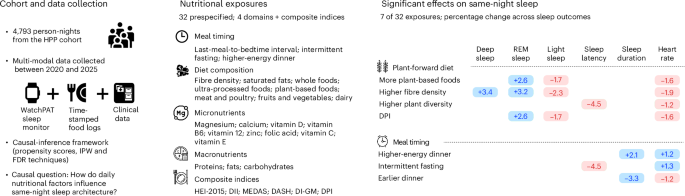
Sleep architecture is essential for metabolic and cardiovascular health, yet the impact of day-to-day dietary variation on objective sleep physiology remains unclear. Using an observational causal-inference framework on 4,793 person-nights with real-time dietary logs and multi-stage wearable sleep recordings, we examined how daily nutritional choices relate to that same night’s sleep under free-living conditions, using a lagged-variable design that controls for the preceding day’s dietary and sleep baseline. Causal effects were estimated using inverse probability weighting with bootstrap-based uncertainty quantification. Higher fibre density was associated with increased restorative sleep, including +0.59 percentage points deep sleep (95% confidence interval (CI) = [0.25, 0.94]; P = 0.008), +0.76 percentage points REM sleep (95% CI = [0.21, 1.29]; P = 0.008), −1.35 percentage points light sleep (95% CI = [−2.08, −0.59]; P < 0.01) and −1.14 beats per minute (bpm) mean nocturnal heart rate (95% CI = [−1.67, −0.60]; P < 0.01). Greater plant diversity, defined as the daily count of unique plant-based food items, and higher whole-plant food intake were similarly associated with lower nocturnal heart rate. Meal-timing behaviours primarily influenced sleep duration and autonomic tone. Heavier evening meals, defined by the percentage of total daily energy consumed in the 6 h preceding bedtime, were associated with +7.7 min longer total sleep time (95% CI = [3.71, 12.37]; P < 0.01) and +0.73 bpm higher nocturnal heart rate (95% CI = [0.19, 1.26]; P = 0.032). The Dietary Phytochemical Index was also significantly associated with more restorative sleep-stage composition, including increased REM sleep (+0.62 percentage points; 95% CI = [0.11, 1.19]; P = 0.012), decreased light sleep (−1.00 percentage points; 95% CI = [−1.79, −0.28]; P = 0.006) and lower mean nocturnal heart rate (−0.93 bpm; 95% CI = [−1.48, −0.33]; P = 0.002). In contrast, short-term variation in macronutrient energy distribution and micronutrient consumption showed no robust associations after false discovery rate correction. When our analyses were restricted to more extreme dietary contrasts, the effect magnitudes increased while remaining directionally consistent. These findings indicate that routine daily dietary choices, particularly plant-forward composition and meal timing, have immediate and measurable effects on objective sleep architecture.
This is a preview of subscription content, access
Access options
Access through your institution
- Purchase on SpringerLink
- Instant access to the full article PDF.
39,95 €
Prices may be subject to local taxes which are calculated during checkout
Subjects
- Epidemiology
- Nutrition
Data availability
The data in this paper are part of the HPP and are accessible to researchers from universities and other research institutions at: https://humanphenotypeproject.org/data-access. The HPP data include personal information and, in compliance with Institutional Review Board regulations, cannot be made publicly available. Interested researchers should contact info@pheno.ai to obtain instructions for accessing the data. Access is typically granted within a few days
Code availability
The code used to produce the results presented in the study (the causal-inference pipeline, preprocessing steps and figure generation) is publicly available at https://github.com/mashaashkolnik/causal_framework
References
Spiegel, K., Leproult, R. & Van Cauter, E. Impact of sleep debt on metabolic and endocrine function. Lancet354, 1435–1439 (1999)
He, J. & He, Q. Association between sleep duration and hypertension among adults in Southwest China. Glob. Heart17, 10 (2022)
Taheri, S., Lin, L., Austin, D., Young, T. & Mignot, E. Short sleep duration is associated with reduced leptin, elevated ghrelin, and increased body mass index. PLoS Med.1, e62 (2004)
Stickgold, R. Sleep-dependent memory consolidation. Nature437, 1272–1278 (2005)
Palmer, C. A. et al. Sleep loss and emotion: a systematic review and meta-analysis of over 50 years of experimental research. Psychol. Bull.150, 440–463 (2024)
Direksunthorn, T. Sleep and cardiometabolic health: a narrative review of epidemiological evidence, mechanisms, and interventions. Int. J. Gen. Med.18, 5831–5843 (2025)
Peuhkuri, K., Sihvola, N. & Korpela, R. Diet promotes sleep duration and quality. Nutr. Res.32, 309–319 (2012)
Godos, J. et al. Mediterranean diet and sleep features: a systematic review of current evidence. Nutrients16, 282 (2024)
Polianovskaia, A., Jonelis, M. & Cheung, J. The impact of plant-rich diets on sleep: a mini-review. Front. Nutr.11, 1239580 (2024)
Liu, J. et al. The relationship between plant-based diet indices and sleep health in older adults: the mediating role of depressive symptoms and anxiety. Nutrients16, 3386 (2024)
Zuraikat, F. M., Wood, R. A., Barragán, R. & St-Onge, M.-P. Sleep and diet: mounting evidence of a cyclical relationship. Annu. Rev. Nutr.41, 309–332 (2021)
St-Onge, M.-P., Roberts, A., Shechter, A. & Choudhury, A. R. Fiber and saturated fat are associated with sleep arousals and slow wave sleep. J. Clin. Sleep Med.12, 19–24 (2016)
Chen, Y., Zhao, Z., Ding, W., Zhou, Z. & Xiao, M. Association between dietary fiber intake and sleep disorders: based on the NHANES database. Brain Behav.14, e70123 (2024)
Ekici, E. M., Çelik, Ö. M., Göbel, P. & Güzelalp, A. H. Association between ultra-processed food intake, night eating behavior, and sleep quality: a cross-sectional study from Türkiye. Health Qual. Life Outcomes23, 103 (2025)
Lana, A. et al. Habitual meat consumption and changes in sleep duration and quality in older adults. Aging Dis.10, 267–277 (2019)
Wirth, J., Lin, K., Brennan, L., Wu, K. & Giovannucci, E. Protein intake and its association with sleep quality: results from 3 prospective cohort studies. Eur. J. Clin. Nutr.78, 413–419 (2024)
Wu, Q. et al. Associations between dietary nutrient intake and sleep disorders in cancer survivors base on NHANES 2005 to 2018. Sci. Rep.14, 26160 (2024)
Peres, A. P. et al. The consumption of milk or dairy products and sleep quality: a systematic review and meta-analysis. Cureus17, e92556 (2025)
St-Onge, M.-P., Zuraikat, F. M. & Neilson, M. Exploring the role of dairy products in sleep quality: from population studies to mechanistic evaluations. Adv. Nutr.14, 283–294 (2023)
St-Onge, M.-P., Mikic, A. & Pietrolungo, C. E. Effects of diet on sleep quality. Adv. Nutr.7, 938–949 (2016)
Lehmann, L. et al. A delayed evening meal enhances sleep quality in young rugby players. Int. J. Sport Nutr. Exerc. Metab.33, 39–46 (2023)
Duan, D., Gu, C., Polotsky, V. Y., Jun, J. C. & Pham, L. V. Effects of dinner timing on sleep stage distribution and EEG power spectrum in healthy volunteers. Nat. Sci. Sleep13, 601–612 (2021)
Bohlman, C. et al. The effects of time-restricted eating on sleep in adults: a systematic review of randomized controlled trials. Front. Nutr.11, 1419811 (2024)
Falkenberg, E., Aisbett, B., Lastella, M., Roberts, S. & Condo, D. Nutrient intake, meal timing and sleep in elite male Australian football players. J. Sci. Med. Sport24, 7–12 (2021)
Chung, N., Bin, Y. S., Cistulli, P. A. & Chow, C. M. Does the proximity of meals to bedtime influence the sleep of young adults? A cross-sectional survey of university students. Int. J. Environ. Res. Public Health17, 2677 (2020)
Yan, L.-M., Li, H.-J., Fan, Q., Xue, Y.-D. & Wang, T. Chronobiological perspectives: association between meal timing and sleep quality. PLoS ONE19, e0308172 (2024)
Nehme, P. et al. Effects of a carbohydrate-enriched night meal on sleepiness and sleep duration in night workers: a double-blind intervention. Chronobiol. Int.31, 453–460 (2014)
Vlahoyiannis, A. et al. Effects of high vs. low glycemic index of post-exercise meals on sleep and exercise performance: a randomized, double-blind, counterbalanced polysomnographic study. Nutrients10, 1795 (2018)
Afaghi, A., O’Connor, H. & Chow, C. M. High-glycemic-index carbohydrate meals shorten sleep onset. Am. J. Clin. Nutr.85, 426–430 (2007)
Steger, F. L. et al. Early time-restricted eating affects weight, metabolic health, mood, and sleep in adherent completers: a secondary analysis. Obesity (Silver Spring)31, 96–107 (2023)
Iao, S. I. et al. Associations between bedtime eating or drinking, sleep duration and wake after sleep onset: findings from the American time use survey. Br. J. Nutr.127, 1888–1897 (2022)
Chong, M. Y. et al. Longitudinal associations of circadian eating patterns with sleep quality, fatigue and inflammation in colorectal cancer survivors up to 24 months post-treatment. Br. J. Nutr.131, 1166–1180 (2024)
Arab, A., Rafie, N., Amani, R. & Shirani, F. The role of magnesium in sleep health: a systematic review of available literature. Biol. Trace Elem. Res.201, 121–128 (2023)
Hausenblas, H. A. et al. Magnesium-L-threonate improves sleep quality and daytime functioning in adults with self-reported sleep problems: a randomized controlled trial. Sleep Med. X8, 100121 (2024)
Zhang, Y. et al. Association of magnesium intake with sleep duration and sleep quality: findings from the CARDIA study. Sleep45, zsab276 (2022)
Ikonte, C. J., Mun, J. G., Reider, C. A., Grant, R. W. & Mitmesser, S. H. Micronutrient inadequacy in short sleep: analysis of the NHANES 2005–2016. Nutrients11, 2335 (2019)
Mirzaei-Azandaryani, Z., Abdolalipour, S. & Mirghafourvand, M. The effect of vitamin D on sleep quality: a systematic review and meta-analysis. Nutr. Health28, 515–526 (2022)
Abboud, M. Vitamin D supplementation and sleep: a systematic review and meta-analysis of intervention studies. Nutrients14, 1076 (2022)
Thongchumnum, W., Vallibhakara, S. A.-O., Sophonsritsuk, A. & Vallibhakara, O. Effect of vitamin E supplementation on chronic insomnia disorder in postmenopausal women: a prospective, double-blinded randomized controlled trial. Nutrients15, 1187 (2023)
Jazinaki, M. S. et al. Effects of zinc supplementation on sleep quality in humans: a systematic review of randomized controlled trials. Health Sci. Rep.7, e70019 (2024)
Tu, J. et al. Association of different folate statuses with sleep disturbances in adults in the US: data from NHANES 2007–2016. Sleep Health11, 326–334 (2025)
Adventure-Heart, D. J., Madden, N. A. & Delfabbro, P. Effects of vitamin B6 (pyridoxine) and a B complex preparation on dreaming and sleep. Percept. Mot. Skills125, 451–462 (2018)
Hysing, M. et al. The effect of vitamin B12-supplementation on actigraphy measured sleep pattern; a randomized control trial. Clin. Nutr.41, 307–312 (2022)
Zhao, M., Tuo, H., Wang, S. & Zhao, L. The effects of dietary nutrition on sleep and sleep disorders. Mediat. Inflamm.2020, 3142874 (2020)
Isoda, A., Kiriya, J. & Jimba, M. Association between calcium intake and sleep quality: a systematic review. BMJ Nutr. Prev. Health8, e001130 (2025)
Robins, J. M., Hernán, M. A. & Brumback, B. Marginal structural models and causal inference in epidemiology. Epidemiology11, 550–560 (2000)
Rosenbaum, P. R. & Rubin, D. B. The central role of the propensity score in observational studies for causal effects. Biometrika70, 41–55 (1983)
Hernán, M. A. & Robins, J. M. Using big data to emulate a target trial when a randomized trial is not available. Am. J. Epidemiol.183, 758–764 (2016)
Von Elm, E. et al. The Strengthening the Reporting of Observational Studies in Epidemiology (STROBE) statement: guidelines for reporting observational studies. Int. J. Surg.12, 1495–1499 (2014)
Sterne, J. A. C. et al. ROBINS-I: a tool for assessing risk of bias in non-randomised studies of interventions. Br. Med. J.355, i4919 (2016)
Lachat, C. et al. Strengthening the Reporting of Observational Studies in Epidemiology—nutritional epidemiology (STROBE-nut): an extension of the STROBE statement. Nutr. Bull.41, 240–251 (2016)
Shilo, S. et al. 10 K: a large-scale prospective longitudinal study in Israel. Eur. J. Epidemiol.36, 1187–1194 (2021)
Hernán, M. A., Dahabreh, I. J., Dickerman, B. A. & Swanson, S. A. The target trial framework for causal inference from observational data: why and when is it helpful? Ann. Intern. Med.178, 402–407 (2025)
Hubbard, R. A. et al. ‘Target trial emulation’ for observational studies—potential and pitfalls. N. Engl. J. Med.391, 1975–1977 (2024)
Stuart, E. A. Matching methods for causal inference: a review and a look forward. Stat. Sci.25, 1–21 (2010)
Li, F., Thomas, L. E. & Li, F. Addressing extreme propensity scores
Shiba, K. & Kawahara, T. Using propensity scores for causal inference: pitfalls and tips. J. Epidemiol.31, 457–463 (2021)
Leite, W. et al. Machine learning for propensity score estimation: a systematic review and reporting guidelines. Psychol. Methodshttps://doi.org/10.1037/met0000789 (2025)
Khan, S. & Ugander, J. Adaptive normalization for IPW estimation. J. Causal Inference11, 1–33 (2023)
Lipsitch, M., Tchetgen Tchetgen, E. & Cohen, T. Negative controls: a tool for detecting confounding and bias in observational studies. Epidemiology21, 383–388 (2010)
Kohn, S. et al. Phenome-wide associations of sleep characteristics in the Human Phenotype Project. Nat. Med.31, 1026–1037 (2025)
Rein, M., Elkan, M., Godneva, A., Dolev, N. C. & Segal, E. Sex-specific dietary habits and their association with weight change in healthy adults. BMC Med.22, 512 (2024)
Parast, L., Hunt, P., Griffin, B. A. & Powell, D. When is a match sufficient? A score-based balance metric for the synthetic control method. J. Causal Inference8, 209–228 (2020)
Bruning, J. et al. Gut microbiota and short chain fatty acids: influence on the autonomic nervous system. Neurosci. Bull.36, 91–95 (2020)
Majumdar, A., Siva Venkatesh, I. P. & Basu, A. Short-chain fatty acids in the microbiota–gut–brain axis: role in neurodegenerative disorders and viral infections. ACS Chem. Neurosci.14, 1045–1062 (2023)
Thayer, J. F. & Fischer, J. E. Heart rate variability, overnight urinary norepinephrine and C-reactive protein: evidence for the cholinergic anti-inflammatory pathway in healthy human adults. J. Intern. Med.265, 439–447 (2009)
Madsen, T., Christensen, J. H., Toft, E. & Schmidt, E. B. C-reactive protein is associated with heart rate variability. Ann. Noninvasive Electrocardiol.12, 216–222 (2007)
Waaler, B. A., Eriksen, M. & Toska, K. The effect of meal size on postprandial increase in cardiac output. Acta Physiol. Scand.142, 33–39 (1991)
van Baak, M. A. Meal-induced activation of the sympathetic nervous system and its cardiovascular and thermogenic effects in man. Physiol. Behav.94, 178–186 (2008)
Lu, C. L., Zou, X. P., Orr, W. C. & Chen, J. D. Z. Postprandial changes of sympathovagal balance measured by heart rate variability. Gastroenterology114, A796 (1998)
Frank, S. et al. Diet and sleep physiology: public health and clinical implications. Front. Neurol.8, 393 (2017)
Hall, W. L. The emerging importance of tackling sleep–diet interactions in lifestyle interventions for weight management. Br. J. Nutr.128, 561–568 (2022)
Chellappa, S. L. et al. Daytime eating during simulated night work mitigates changes in cardiovascular risk factors: secondary analyses of a randomized controlled trial. Nat. Commun.16, 3186 (2025)
Khan, S. & Ugander, J. Doubly robust and heteroscedasticity-aware sample trimming for causal inference. Biometrika112, asae053 (2025)
Gardiner, C. L. et al. Dose and timing effects of caffeine on subsequent sleep: a randomized clinical crossover trial. Sleep48, zsae230 (2025)
Landolt, H. P., Werth, E., Borbély, A. A. & Dijk, D. J. Caffeine intake (200 mg) in the morning affects human sleep and EEG power spectra at night. Brain Res.675, 67–74 (1995)
Drake, C., Roehrs, T., Shambroom, J. & Roth, T. Caffeine effects on sleep taken 0, 3, or 6 hours before going to bed. J. Clin. Sleep Med.9, 1195–1200 (2013)
Acknowledgements
We thank the HPP participants and HPP study team for building and maintaining the cohort infrastructure that made this analysis possible
Funding
E.S. is supported by the Crown Human Genome Center, Larson Charitable Foundation New Scientist Fund, Else Kröner-Fresenius Foundation, White Rose International Foundation, Ben B. and Joyce E. Eisenberg Foundation, Nissenbaum Family, Marcos Pinheiro de Andrade and Vanessa Buchheim, Lady Michelle Michels, Aliza Moussaieff and grants funded by the Minerva Foundation (with funding from the German Federal Ministry of Education and Research), European Research Council and Israel Science Foundation
Author information
Authors and Affiliations
Department of Computer Science and Applied Mathematics, Weizmann Institute of Science, Rehovot, Israel
Mariya Shkolnik, Gal Sapir, Smadar Shilo, Yeela Talmor-Barkan & Eran Segal
Pheno.AI, Tel Aviv, Israel
Gal Sapir & Hagai Rossman
Gray Faculty of Medical and Health Sciences, Tel Aviv University, Tel Aviv, Israel
Smadar Shilo & Yeela Talmor-Barkan
The Jesse Z and Sara Lea Shafer Institute for Endocrinology and Diabetes, National Center for Childhood Diabetes, Schneider Children’s Medical Center of Israel, Petah Tikva, Israel
Smadar Shilo
Department of Molecular Cell Biology, Weizmann Institute of Science, Rehovot, Israel
Yeela Talmor-Barkan
Department of Cardiology, Rabin Medical Center, Petah Tikva, Israel
Yeela Talmor-Barkan
Mohamed bin Zayed University of Artificial Intelligence, Abu Dhabi, United Arab Emirates
Eran Segal & Hagai Rossman
Authors
- Mariya ShkolnikView author publications
Search author on:PubMed Google Scholar
- Gal SapirView author publications
Search author on:PubMed Google Scholar
- Smadar ShiloView author publications
Search author on:PubMed Google Scholar
- Yeela Talmor-BarkanView author publications
Search author on:PubMed Google Scholar
- Eran SegalView author publications
Search author on:PubMed Google Scholar
- Hagai RossmanView author publications
Search author on:PubMed Google Scholar
Contributions
M.S. conceived of the project, designed and conducted all of the analyses, interpreted the results and wrote the paper. G.S., S.S. and Y.T.-B. contributed to clinical interpretation and paper revision. H.R. and E.S. conceived of and supervised the study and revised the paper
Ethics declarations
Competing interests
G.S. and H.R. are employees of Pheno.AI, a biomedical data science company based in Tel Aviv, Israel. E.S. and Y.T.-B. are paid consultants of Pheno.AI. The other authors declare no competing interests
Peer review
Peer review information
Nature Health thanks Xiaopeng Ji and the other, anonymous, reviewer(s) for their contribution to the peer review of this work. Peer reviewer reports are available. Primary Handling Editor: Lorenzo Righetto, in collaboration with the Nature Health team
Additional information
Publisher’s note Springer Nature remains neutral with regard to jurisdictional claims in published maps and institutional affiliations
Extended Data
Extended Data Fig. 1 Data selection and sample sizes
Flow chart showing the different sample sizes of the data available at the time of this work, after the selection process
Supplementary information
Supplementary Information (download PDF )
Supplementary text (null findings and their interpretation and extreme intake contrasts) and Supplementary Figs. 1–3
Reporting Summary (download PDF )
Peer Review File (download PDF )
Rights and permissions
Springer Nature or its licensor (e.g. a society or other partner) holds exclusive rights to this article under a publishing agreement with the author(s) or other rightsholder(s); author self-archiving of the accepted manuscript version of this article is solely governed by the terms of such publishing agreement and applicable law
About this article
Cite this article
Shkolnik, M., Sapir, G., Shilo, S. et al. Impact of daily diet on sleep quality.
Nat. Health (2026). https://doi.org/10.1038/s44360-026-00182-2
Received:23 April 2026
Accepted:13 July 2026
Published:19 August 2026
Version of record:19 August 2026
DOI
:https://doi.org/10.1038/s44360-026-00182-2
