


Abstract
Background
The impact of meal timing and eating window on mortality and life expectancy remains unclear
Methods
This cohort study included 31,044 adults aged 40 years and older from the National Health and Nutrition Examination Survey 1999–2018. The meal timing and the eating window were estimated from a 24-h dietary recall
Results
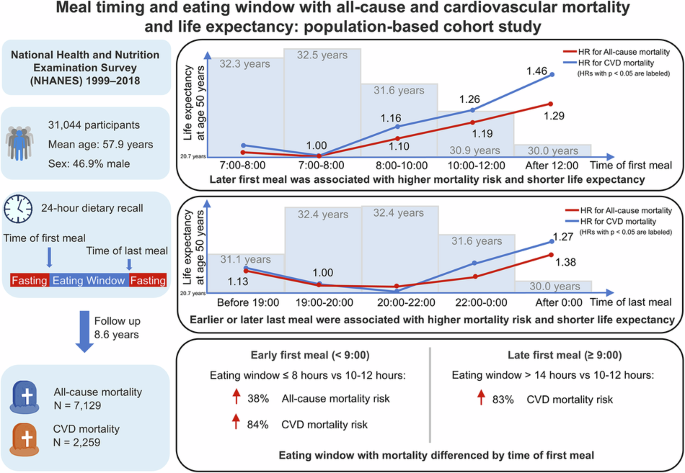
During a median (IQR) follow-up of 8.6 (4.5–13.0) years, 7129 deaths were documented. Compared with a first meal within 7:00–8:00, the hazard ratios (HRs) and 95% CIs of all-cause mortality were 1.10 (1.02–1.18), 1.19 (1.05–1.34), and 1.29 (1.10–1.51) for a first meal within 8:00–10:00, 10:00–12:00, and after 12:00, respectively. Compared with a last meal within 19:00–20:00, the HR of all-cause mortality was 1.13 (1.03–1.25) for a last meal before 19:00, and 1.27 (1.06–1.54) for eating after midnight. The associations were also observed for cardiovascular mortality. The association between eating window and cardiovascular mortality risk varied by first meal timing. At the age of 50 years, the estimated life expectancy was on average 2.46 (0.61–4.28) years shorter among participants having a first meal after 12:00 and 2.35 (0.82–5.14) years shorter among those having a last meal after midnight compared with reference groups.
Conclusions
Later first meals and earlier or later last meals were associated with higher mortality risks and shorter life expectancy. These findings suggest that meal timing may be a modifiable behavioral factor associated with mortality risk and life expectancy
This is a preview of subscription content, access
Access options
Access through your institution
- Purchase on SpringerLink
- Instant access to the full article PDF.
39,95 €
Prices may be subject to local taxes which are calculated during checkout
Subjects
- Epidemiology
- Risk factors
Data availability
The datasets used in the current study are publicly available through the National Health and Nutrition Examination Survey (NHANES) website at https://wwwn.cdc.gov/nchs/nhanes/Default.aspx. The data underlying this article will be shared on reasonable request to the corresponding author
References
Reinke H, Asher G. Crosstalk between metabolism and circadian clocks. Nat Rev Mol Cell Biol. 2019;20:227–41
Longo VD, Panda S. Fasting, circadian rhythms, and time-restricted feeding in healthy lifespan. Cell Metab. 2016;23:1048–59
Kant AK, Graubard BI. 40-year trends in meal and snack eating behaviors of American adults. J Acad Nutr Diet. 2015;115:50–63
Farsijani S, Mao Z, Cauley JA, Newman AB. Comprehensive assessment of chrononutrition behaviors among nationally representative adults: insights from National Health and Nutrition Examination Survey (NHANES) data. Clin Nutr. 2023;42:1910–21
Challet E. The circadian regulation of food intake. Nat Rev Endocrinol. 2019;15:393–405
Garaulet M, Qian J, Florez JC, Arendt J, Saxena R, Scheer FAJL. Melatonin effects on glucose metabolism: time to unlock the controversy. Trends Endocrinol Metab. 2020;31:192–204
Chen H, Zhang B, Ge Y, Shi H, Song S, Xue W, et al. Association between skipping breakfast and risk of cardiovascular disease and all-cause mortality: a meta-analysis. Clin Nutr. 2020;39:2982–8
Sun Y, Rong S, Liu B, Du Y, Wu Y, Chen L, et al. Meal skipping and shorter meal intervals are associated with increased risk of all-cause and cardiovascular disease mortality among US adults. J Acad Nutr Diet. 2023;123:417–426.e3
Kant AK, Graubard BI. Clock time of first eating episode and prospective risk of all-cause mortality in US adults. J Nutr. 2022;152:217–26
Wang P, Tan Q, Zhao Y, Zhao J, Zhang Y, Shi D. Night eating in timing, frequency, and food quality and risks of all-cause, cancer, and diabetes mortality: findings from National Health and Nutrition Examination Survey. Nutr Diab. 2024;14:5
Manoogian ENC, Zadourian A, Lo HC, Gutierrez NR, Shoghi A, Rosander A, et al. Feasibility of time-restricted eating and impacts on cardiometabolic health in 24-h shift workers: the healthy heroes randomized control trial. Cell Metab. 2022;34:1442–1456.e7
Li C, Xing C, Zhang J, Zhao H, Shi W, He B. Eight-hour time-restricted feeding improves endocrine and metabolic profiles in women with anovulatory polycystic ovary syndrome. J Transl Med. 2021;19:148
Dawson MA, Cheung SN, La Frano MR, Nagpal R, Berryman CE. Early time-restricted eating improves markers of cardiometabolic health but has no impact on intestinal nutrient absorption in healthy adults. Cell Rep Med. 2024;5:101363
Chudasama YV, Khunti K, Gillies CL, Dhalwani NN, Davies MJ, Yates T, et al. Estimates of years of life lost depended on the method used: tutorial and comparative investigation. J Clin Epidemiol. 2022;150:42–50
Chen T-C, Clark J, Riddles MK, Mohadjer LK, Fakhouri THI. National health and nutrition examination survey, 2015–2018: sample design and estimation procedures. Vital Health Stat 2. 2020;184:1–35
Gill S, Panda S. A smartphone app reveals erratic diurnal eating patterns in humans that can be modulated for health benefits. Cell Metab. 2015;22:789–98
Shams-White MM, Pannucci TE, Lerman JL, Herrick KA, Zimmer M, Meyers Mathieu K, et al. Healthy eating index-2020: review and update process to reflect the dietary guidelines for Americans, 2020–2025. J Acad Nutr Diet. 2023;123:1280–8
Smith KJ, Gall SL, McNaughton SA, Blizzard L, Dwyer T, Venn AJ. Skipping breakfast: longitudinal associations with cardiometabolic risk factors in the childhood determinants of adult health study. Am J Clin Nutr. 2010;92:1316–25
Li Y, Pan A, Wang DD, Liu X, Dhana K, Franco OH, et al. Impact of healthy lifestyle factors on life expectancies in the US population. Circulation. 2018;138:345–55
Rong S, Snetselaar LG, Xu G, Sun Y, Liu B, Wallace RB, et al. Association of skipping breakfast with cardiovascular and all-cause mortality. J Am Coll Cardiol. 2019;73:2025–32
Pons-Muzzo L, de Cid R, Obón-Santacana M, Straif K, Papantoniou K, Santonja I, et al. Sex-specific chrono-nutritional patterns and association with body weight in a general population in Spain (GCAT study). Int J Behav Nutr Phys Act. 2024;21:102
Walton K, Horton NJ, Rifas-Shiman SL, Field AE, Austin SB, Haycraft E, et al. Exploring the role of family functioning in the association between frequency of family dinners and dietary intake among adolescents and young adults. JAMA Netw Open. 2018;1:e185217
Blake CE, Wethington E, Farrell TJ, Bisogni CA, Devine CM. Behavioral contexts, food-choice coping strategies, and dietary quality of a multiethnic sample of employed parents. J Am Diet Assoc. 2011;111:401–7
Rahman MO. Age and gender variation in the impact of household structure on elderly mortality. Int J Epidemiol. 1999;28:485–91
Gu F, Han J, Laden F, Pan A, Caporaso NE, Stampfer MJ, et al. Total and cause-specific mortality of U.S. nurses working rotating night shifts. Am J Prev Med. 2015;48:241–52
Liu J, Yi P, Liu F. The effect of early time-restricted eating vs later time-restricted eating on weight loss and metabolic health. J Clin Endocrinol Metab. 2023;108:1824–34
Xie Z, Sun Y, Ye Y, Hu D, Zhang H, He Z, et al. Randomized controlled trial for time-restricted eating in healthy volunteers without obesity. Nat Commun. 2022;13:1003
Manoogian ENC, Chow LS, Taub PR, Laferrère B, Panda S. Time-restricted Eating for the Prevention and Management of Metabolic Diseases. Endocr Rev. 2022;43:405–36
Semnani-Azad Z, Khan TA, Chiavaroli L, Chen V, Bhatt HA, Chen A, et al. Intermittent fasting strategies and their effects on body weight and other cardiometabolic risk factors: systematic review and network meta-analysis of randomised clinical trials. BMJ. 2025;389:e082007
Parr EB, Kouw IWK, Wheeler MJ, Radford BE, Hall RC, Senden JM, et al. Eight-hour time-restricted eating does not lower daily myofibrillar protein synthesis rates: a randomized controlled trial. Obesity. 2023;31:116–26
Li L, Li R, Tian Q, Luo Y, Li R, Lin X, et al. Effects of healthy low-carbohydrate diet and time-restricted eating on weight and gut microbiome in adults with overweight or obesity: feeding RCT. Cell Rep Med. 2024;5:101801
Wang N, Xiao Y, Zhang W, Doherty M, Zhang Y, Xie J, et al. Sarcopenia and risk of cardiovascular events and mortality: a meta-analysis of longitudinal observational studies. Can J Cardiol. 2026. https://doi.org/10.1016/j.cjca.2026.02.054
Mao Z, Cawthon PM, Kritchevsky SB, Toledo FGS, Esser KA, Erickson ML, et al. The association between chrononutrition behaviors and muscle health among older adults: the study of muscle, mobility and aging. Aging Cell. 2023;23:e14059
Estrada-de León DB, Struijk EA, Caballero FF, Ortolá R, Guallar-Castillón P, Banegas JR, et al. Association of prolonged nightly fasting with cardiovascular, renal, inflammation, and nutritional status biomarkers in community-dwelling older adults. Am J Clin Nutr. 2022;115:1282–9
Cheng W, Meng X, Gao J, Jiang W, Sun X, Li Y, et al. Relationship between circadian eating behavior (daily eating frequency and nighttime fasting duration) and cardiovascular mortality. Int J Behav Nutr Phys Act. 2024;21:22
Ma H, Wang X, Xue Q, Li X, Liang Z, Heianza Y, et al. Cardiovascular health and life expectancy among adults in the United States. Circulation. 2023;147:1137–46
Lewis P, Oster H, Korf HW, Foster RG, Erren TC. Food as a circadian time cue – evidence from human studies. Nat Rev Endocrinol. 2020;16:213–23
Shimizu H, Hanzawa F, Kim D, Sun S, Laurent T, Umeki M, et al. Delayed first active-phase meal, a breakfast-skipping model, led to increased body weight and shifted the circadian oscillation of the hepatic clock and lipid metabolism-related genes in rats fed a high-fat diet. PLoS One. 2018;13:e0206669
Kim D, Hanzawa F, Sun S, Laurent T, Ikeda S, Umeki M, et al. Delayed meal timing, a breakfast skipping model, increased hepatic lipid accumulation and adipose tissue weight by disintegrating circadian oscillation in rats fed a high-cholesterol diet. Front Nutr. 2021;8:681436
Ni Y, Wu L, Jiang J, Yang T, Wang Z, Ma L, et al. Late-night eating-induced physiological dysregulation and circadian misalignment are accompanied by microbial dysbiosis. Mol Nutr Food Res. 2019;63:1900867
Zhang J, Tian R, Liu J, Yuan J, Zhang S, Chi Z, et al. A two-front nutrient supply environment fuels small intestinal physiology through differential regulation of nutrient absorption and host defense. Cell. 2024;187:6251–71
Fischer D, Lombardi DA, Marucci-Wellman H, Roenneberg T. Chronotypes in the US – influence of age and sex. PLoS One. 2017;12:e0178782
Acknowledgements
The authors are grateful to the members of the National Center for Health Statistics, Centers for Disease Control and Prevention, for gathering the data and making it available for public use. We also thank the participants involved in the survey
Funding
ZS is supported by the National Natural Science Foundation of China (No. 82373567 and No. 82222061), the Noncommunicable Chronic Diseases-National Science and Technology Major Project (2024ZD0531703), and the National Key Research and Development Program of China (2023YFC2506504). The funders had no role in designing or conducting the study; in collecting, managing, analyzing, or interpreting the data; or in deciding to submit the manuscript for publication
Author information
Authors and Affiliations
Department of Nutrition and Food Hygiene, Hubei Key Laboratory of Food Nutrition and Safety, NHC Specialty Laboratory of Food Safety Risk Assessment and Standard Development, School of Public Health, Tongji Medical College, Huazhong University of Science and Technology, Wuhan, China
Wen Hu, Mengyao Wang, Sibo Liu, Qi Wu, Hongkun Di, Tianzhu Qin, Shili Zhou, Liegang Liu & Zhilei Shan
Ministry of Education Key Lab of Environment and Health, School of Public Health, Tongji Medical College, Huazhong University of Science and Technology, Wuhan, China
Wen Hu, Mengyao Wang, Sibo Liu, Qi Wu, Hongkun Di, Tianzhu Qin, Shili Zhou, Yanjun Guo, Liegang Liu & Zhilei Shan
Department of Occupational and Environmental Health, School of Public Health, Tongji Medical College, Huazhong University of Science and Technology, Wuhan, China
Yanjun Guo
Department of Cardiology, Union Hospital, Tongji Medical College, Huazhong University of Science and Technology, Wuhan, China
Xiang Cheng
Department of Epidemiology and Biostatistics, School of Public Health, Tongji Medical College, Huazhong University of Science and Technology, Wuhan, China
Chaolong Wang
Authors
- Wen HuView author publications
Search author on:PubMed Google Scholar
- Mengyao WangView author publications
Search author on:PubMed Google Scholar
- Sibo LiuView author publications
Search author on:PubMed Google Scholar
- Qi WuView author publications
Search author on:PubMed Google Scholar
- Hongkun DiView author publications
Search author on:PubMed Google Scholar
- Tianzhu QinView author publications
Search author on:PubMed Google Scholar
- Shili ZhouView author publications
Search author on:PubMed Google Scholar
- Yanjun GuoView author publications
Search author on:PubMed Google Scholar
- Xiang ChengView author publications
Search author on:PubMed Google Scholar
- Chaolong WangView author publications
Search author on:PubMed Google Scholar
- Liegang LiuView author publications
Search author on:PubMed Google Scholar
- Zhilei ShanView author publications
Search author on:PubMed Google Scholar
Contributions
WH and ZS contributed to the conception and design of the work. WH contributed to the acquisition, analysis, or interpretation of data for the work. WH drafted the manuscript. MW, SL, QW, HD, TQ, SZ, YG, XC, CW, LL, and ZS critically revised the manuscript for important intellectual content. All authors gave final approval and agreed to be accountable for all aspects of the work, ensuring integrity and accuracy
Ethics declarations
Competing interests
The authors declare no competing interests
Ethics approval
The NHANES protocols were reviewed and approved by the National Center for Health Statistics Ethics Review Board, including Protocol #98-12, Protocol #2005-06, Protocol #2011-17, and Protocol #2018-01. All participants provided written informed consent. The present study used publicly available de-identified NHANES data and was conducted in accordance with relevant guidelines and regulations
Additional information
Publisher’s note Springer Nature remains neutral with regard to jurisdictional claims in published maps and institutional affiliations
Supplementary information
Supplementary file (download DOCX )
Rights and permissions
Springer Nature or its licensor (e.g. a society or other partner) holds exclusive rights to this article under a publishing agreement with the author(s) or other rightsholder(s); author self-archiving of the accepted manuscript version of this article is solely governed by the terms of such publishing agreement and applicable law
About this article
Cite this article
Hu, W., Wang, M., Liu, S. et al. Meal timing and eating window with all-cause and cardiovascular mortality and life expectancy: population-based cohort study.
Eur J Clin Nutr (2026). https://doi.org/10.1038/s41430-026-01796-1
Received:28 November 2025
Revised:25 June 2026
Accepted:22 July 2026
Published:31 July 2026
Version of record:31 July 2026
DOI
:https://doi.org/10.1038/s41430-026-01796-1
